
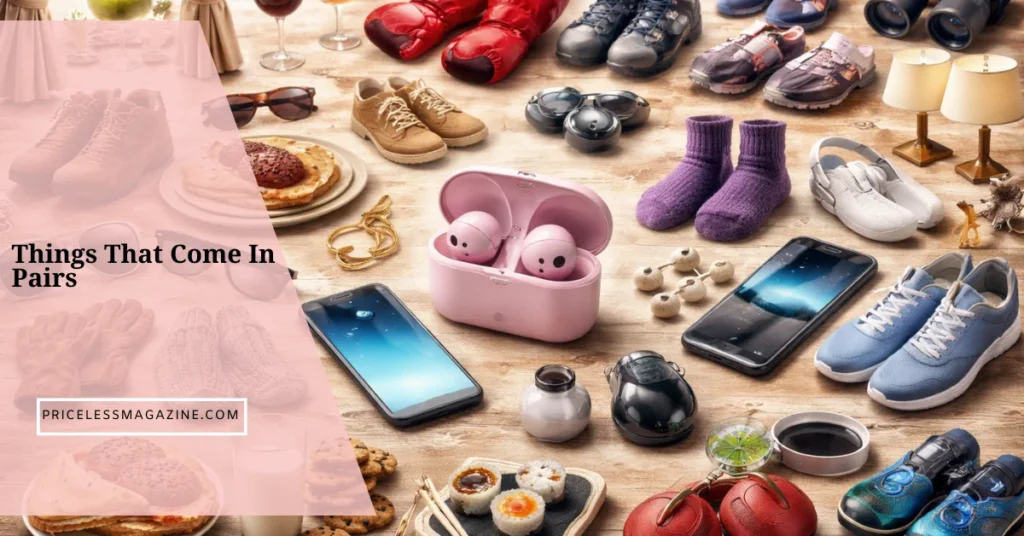

Look around you right now. Your eyes are scanning this screen. Your ears are picking up background sound. Your hands are resting somewhere nearby. Without even thinking about it, your body alone is proof that the world loves a good pair.
Things that come in pairs are everywhere, from the organs keeping you alive to the chopsticks you use at dinner. Some pairs are so familiar we stop noticing them. Others are surprisingly clever once you think about them. This complete list covers over 100 examples across every category, including body parts, clothing, tools, nature, food, technology, and abstract concepts, with grammar tips, fun facts, and a master reference list you can actually use.
What Does “A Pair Of” Mean? (Grammar + Definition)
Before diving into the list, it helps to understand what a pair actually is. A pair refers to two things that belong together, either as one joined object or as two separate items that work as a matched set.
In English, you say a pair of scissors even though scissors is one object. You also say a pair of shoes even though shoes are two separate things. Both uses are correct because both refer to exactly two matching parts functioning together.
Here is a quick grammar guide to avoid confusion:
| Expression | Used For | Example |
|---|---|---|
| A pair of | Two-part items (joined or separate) | A pair of gloves |
| A couple of | Two separate loose items | A couple of dice |
| Some | Informal alternative to “a pair of” | Some shoes |
| A set of | More than two matching items | A set of bowls |
The word pair always refers to exactly two. A set can be any defined quantity. Knowing this difference helps with everyday English, especially for learners.
Body Parts That Come In Pairs
The human body is the most obvious place to start. We carry dozens of paired structures every day without giving them a second thought.
External Paired Body Parts
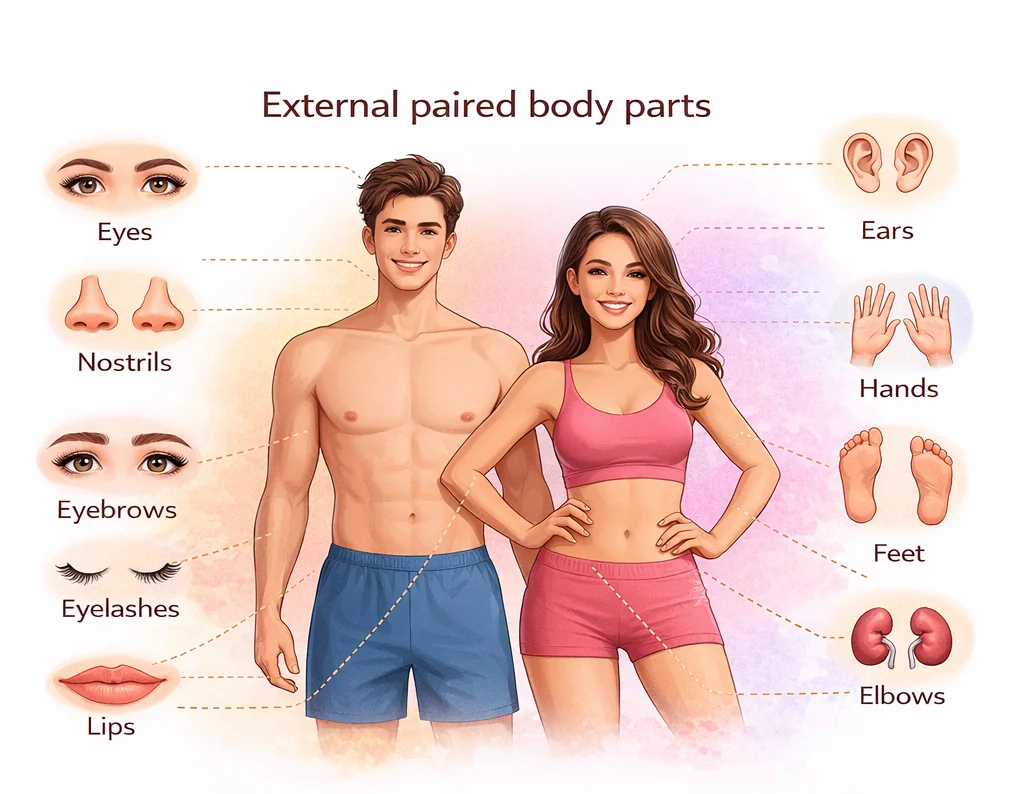
These are the pairs you can see without any medical equipment:
Eyes, ears, nostrils, hands, feet, arms, legs, eyebrows, eyelashes, cheekbones, shoulders, elbows, wrists, thumbs, kneecaps, ankles, temples, lips (upper and lower), shoulder blades, and hips.
Internal Paired Organs
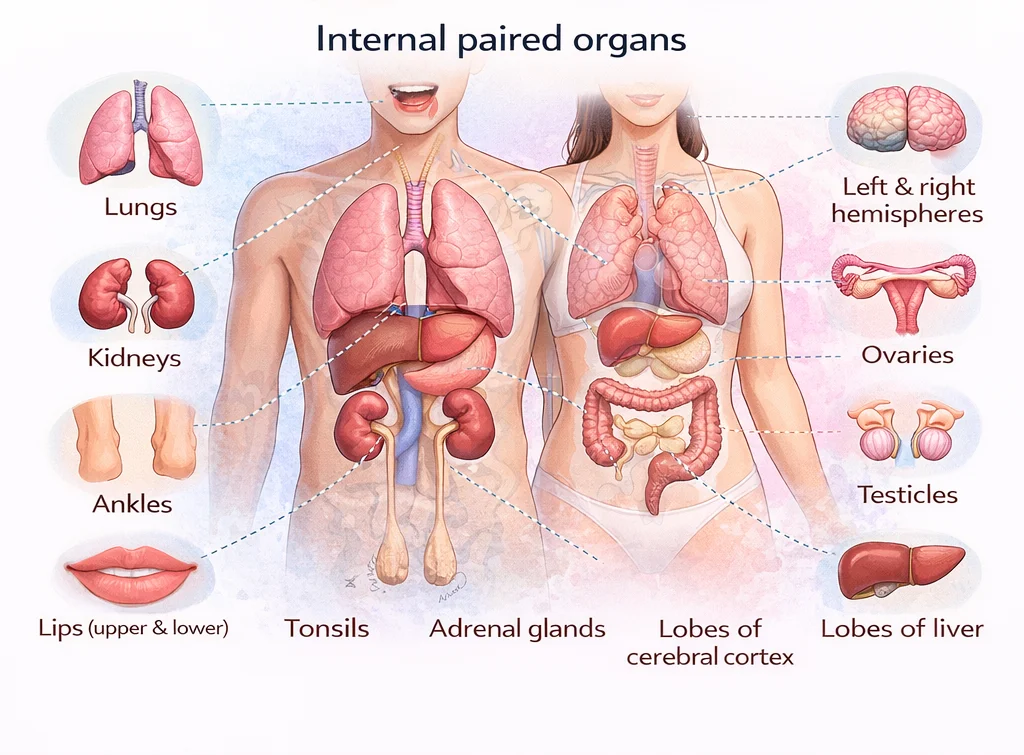
Inside the body, the list is equally impressive:
Lungs, kidneys, ovaries, testicles, tonsils, adrenal glands, fallopian tubes, lobes of the cerebral cortex (left and right hemispheres), and the paired lobes of the liver.
Fun fact: Your two nostrils actually alternate dominance roughly every few hours in a process called the nasal cycle. One nostril does most of the breathing while the other rests, and your brain uses both together to determine the direction a smell is coming from.
Clothing and Accessories That Come In Pairs
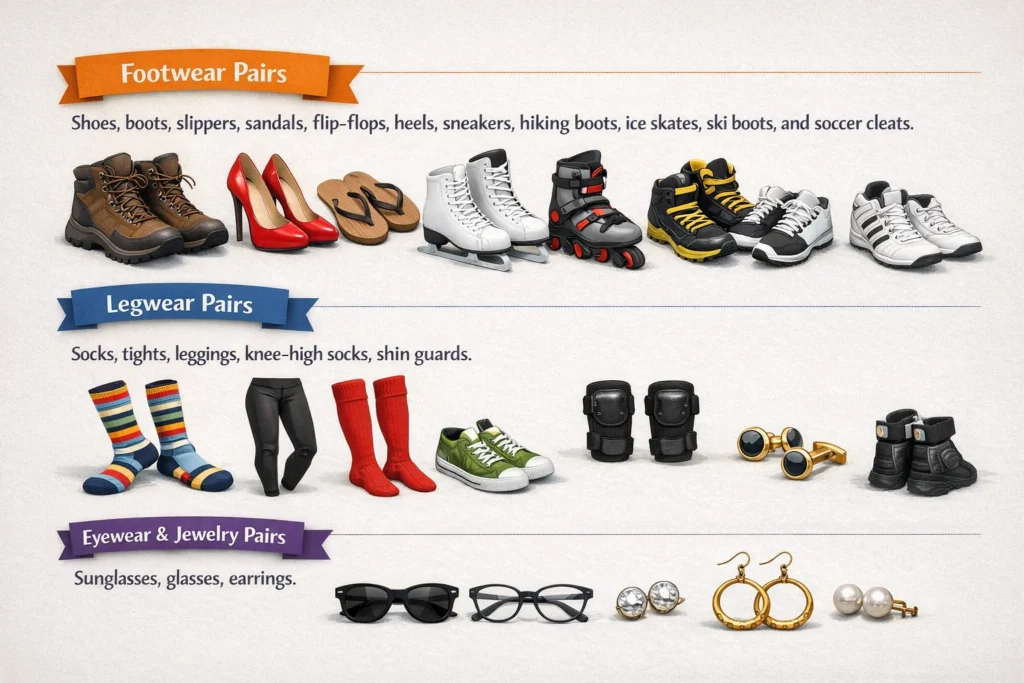
This is probably the category most people think of first, and for good reason. Almost everything we wear on our bodies comes in pairs because our bodies themselves are symmetrical.
Footwear Pairs
Shoes, boots, slippers, sandals, flip-flops, heels, sneakers, hiking boots, roller blades, ice skates, ski boots, and soccer cleats all come in pairs. Interestingly, left and right shoes were not made differently until the 19th century. Before that, both shoes in a pair were identical and your feet simply shaped them over time.
Legwear Pairs
Socks, stockings, tights, leggings, leg warmers, knee-high socks, shin guards, and calf compression sleeves are all sold and worn as pairs.
Hand And Arm Clothing Pairs
Gloves, mittens, oven mitts, wrist guards, elbow pads, and arm warmers all come in pairs. So do cufflinks, the small decorative fasteners worn at shirt cuffs, which are always purchased as a matched pair.
Eyewear And Face Accessories
Sunglasses, prescription glasses, swimming goggles, and contact lenses all count as pairs. Glasses are a single object with two lenses, making them a single-unit pair, while contact lenses are two separate items.
Jewelry Pairs
Earrings are the most universal example. Stud earrings, hoop earrings, drop earrings, and clip-on earrings all come in pairs. Matching bracelets and coordinated shoe clips also fall into this category.
Household Tools and Items That Come In Pairs
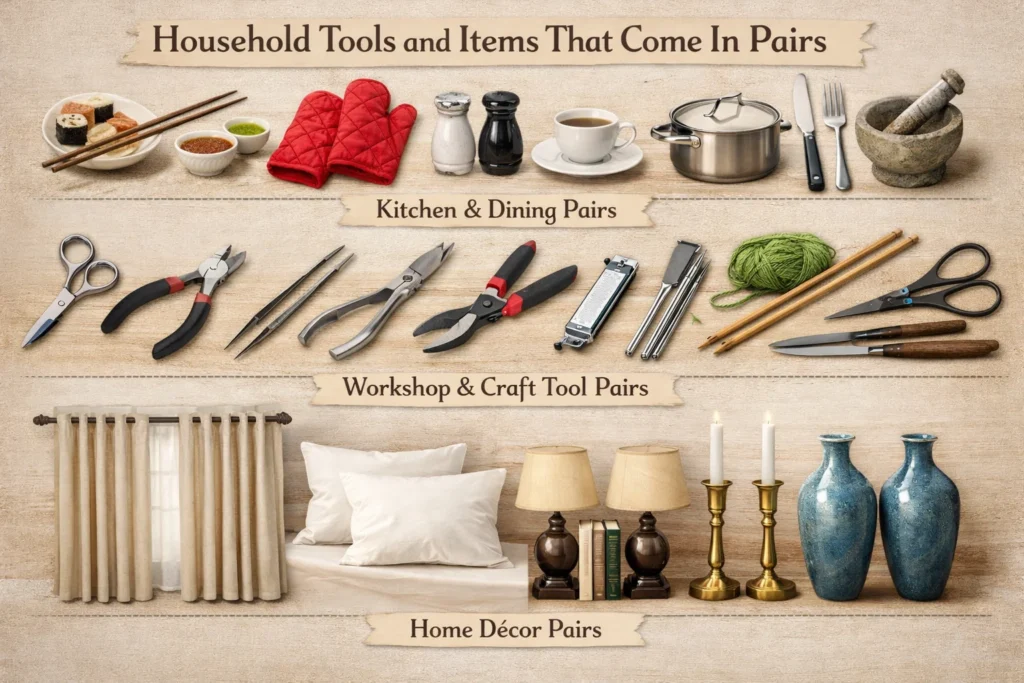
Your home is full of paired items, many of which you use daily without thinking about the pairing.
Kitchen And Dining Pairs
Chopsticks, tongs, oven mitts, salt and pepper shakers, a cup and saucer, a pot and lid, knife and fork, and mortar and pestle are all classic kitchen pairs. Chopsticks are one of the oldest paired utensils in the world, with evidence of use dating back over 5,000 years in China.
Workshop And Craft Tool Pairs
Scissors, pliers, tweezers, shears, clippers, forceps, knitting needles, and crafting tongs all qualify. Most of these are single-unit pairs, meaning the object is one piece but functions because it has two identical halves working together.
Home Décor Pairs
Curtains, pillowcases, bedside lamps, matching bookends, candlestick holders, and decorative vases are frequently purchased and displayed as pairs because symmetry is visually pleasing to the human brain.
Sports Equipment That Comes In Pairs
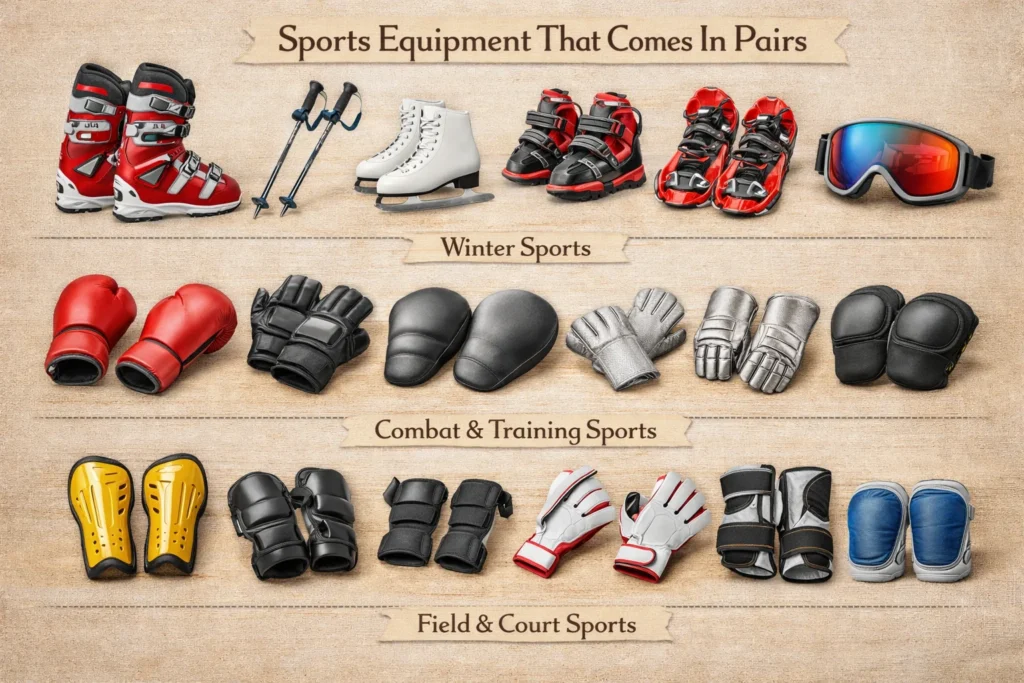
This is one of the most overlooked categories in most lists, but athletes deal with pairs constantly.
Winter sports: Ski poles, ski boots, ice skates, snowshoes, and ski goggles (single unit with dual lenses).
Combat and training sports: Boxing gloves, MMA gloves, sparring mitts, fencing gauntlets, and wrestling knee pads.
Field and court sports: Shin guards for soccer, elbow pads for cycling, wrist guards for skating, batting gloves for baseball, and kneepads for volleyball.
A quick reference table:
| Sport | Paired Equipment |
|---|---|
| Boxing | Boxing gloves |
| Soccer | Shin guards, cleats |
| Ice hockey | Ice skates, shin guards |
| Skiing | Ski poles, ski boots |
| Tennis | Wrist sweatbands |
| Volleyball | Kneepads |
Musical Instruments and Audio Items That Come In Pairs
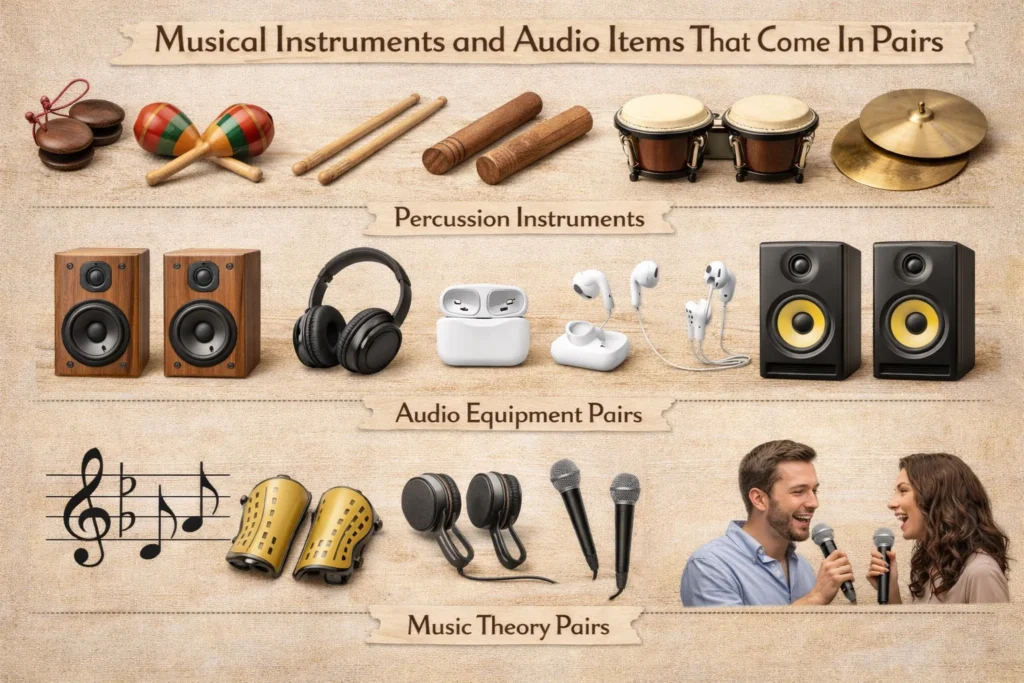
Music is built on pairs in more ways than most people realize, and this is a category that almost no general list covers.
Percussion Instruments
Castanets are clicked together in pairs, held one in each hand. Maracas are always played as a pair. Drumsticks come in pairs. So do claves (the wooden rhythm sticks used in Latin music), bongo drums (two drums connected as one instrument), and cymbals when clashed together.
Audio Equipment Pairs
Stereo speakers, headphones, earbuds, AirPods, and studio monitor speakers all come in pairs. Stereo sound itself is a pair concept. Left channel and right channel audio create the spatial sound experience you hear in music, movies, and podcasts.
The Pair Concept In Music Theory
In music notation, the bass clef and treble clef function together as a pair to represent the full range of musical sound. Vocal harmonies are built on the interplay of paired voices. A duet, by definition, is a pair performing together.
Technology and Modern Items That Come In Pairs
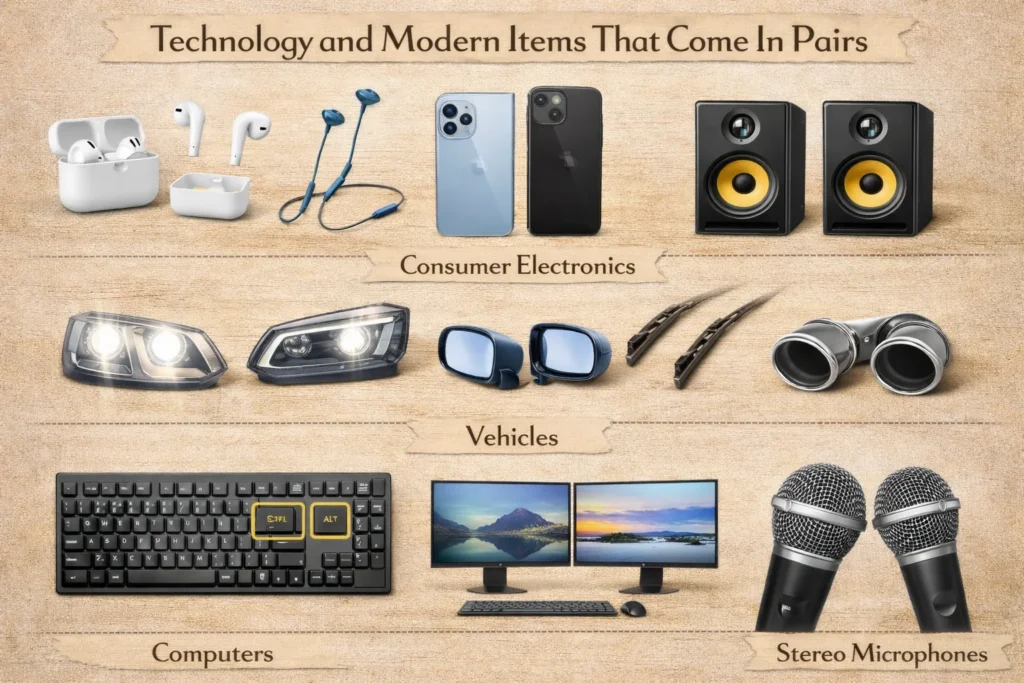
Modern technology has quietly introduced an entirely new generation of pairs into everyday life.
Consumer electronics: True wireless stereo (TWS) earbuds like AirPods, Bluetooth earphones, dual camera systems on smartphones, and stereo speakers are all pairs we interact with daily.
Vehicles: Car headlights, side mirrors, windshield wipers, and dual exhaust pipes are pairs built into almost every vehicle on the road.
Computers: Most keyboards have two Shift keys, two Ctrl keys, and two Alt keys placed on either side for convenience. Desktop setups frequently use dual monitors for productivity. Many devices have stereo microphones built in as a pair for better audio capture.
Things in Nature That Come In Pairs
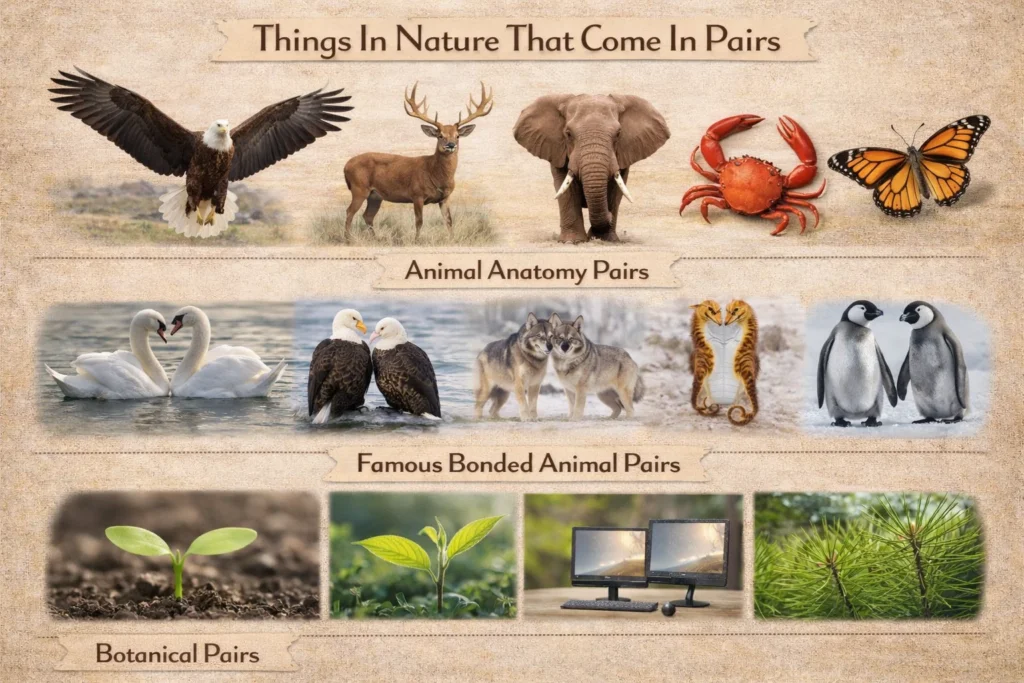
Beyond the human body, the natural world is filled with paired structures.
Animal Anatomy Pairs
Wings on birds and insects, antlers on deer, horns on cattle, tusks on elephants, fins on fish, gills on fish, paws on mammals, claws on crabs, mandibles on insects, antennae on butterflies, compound eye clusters, flippers on seals, and hind legs on all four-legged animals all come in pairs.
Famous Bonded Animal Pairs
Some animals are known for forming lifelong mating pairs. Swans, bald eagles, wolves (the alpha pair in a pack), seahorses, and penguins are among the most well-known animals that mate for life or maintain strong long-term pair bonds.
Botanical Pairs
In the plant world, cotyledons (seed leaves) come in pairs in most flowering plants. Many leaves grow opposite each other on stems in a paired pattern. Pine needles frequently grow in clusters of two. These botanical pairs are a direct expression of bilateral symmetry at the plant level.
Foods and Flavors That Always Come in Pairs
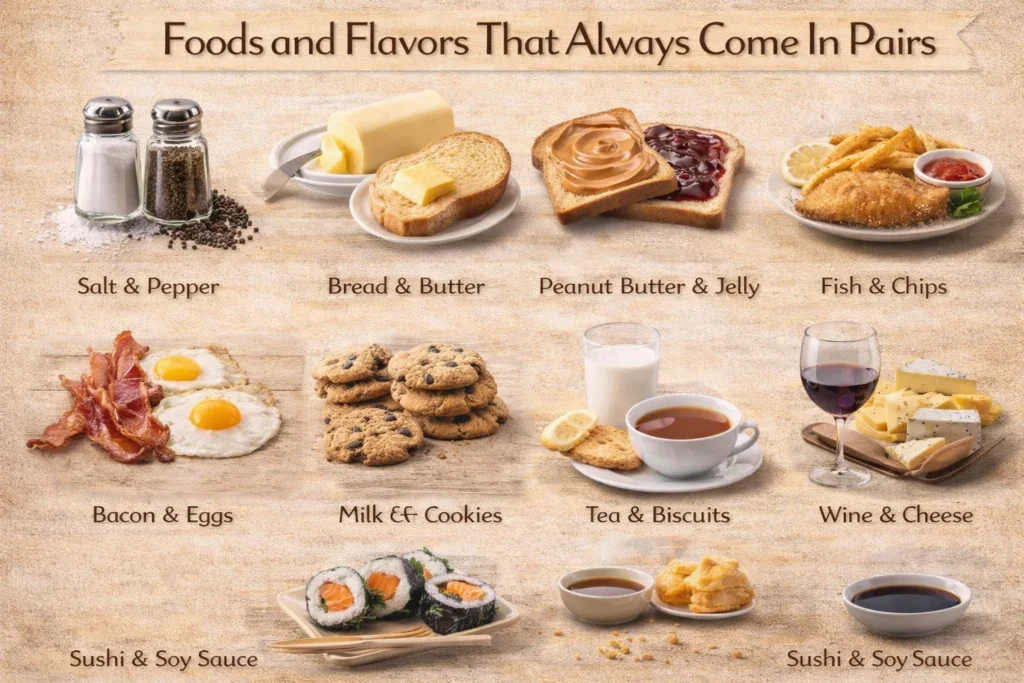
Some foods are so strongly associated with a partner that serving one without the other feels genuinely wrong.
Classic food duos: Salt and pepper, bread and butter, peanut butter and jelly, fish and chips, bacon and eggs, milk and cookies, tea and biscuits, wine and cheese, sushi and soy sauce.
These pairings are not random. They work because of flavor contrast and balance. Salt and pepper balance each other as a savory duo. Peanut butter and jelly combine fat, salt, and sweetness. Most great food pairs follow the same logic: one element provides what the other lacks.
Abstract and Conceptual Things That Come In Pairs
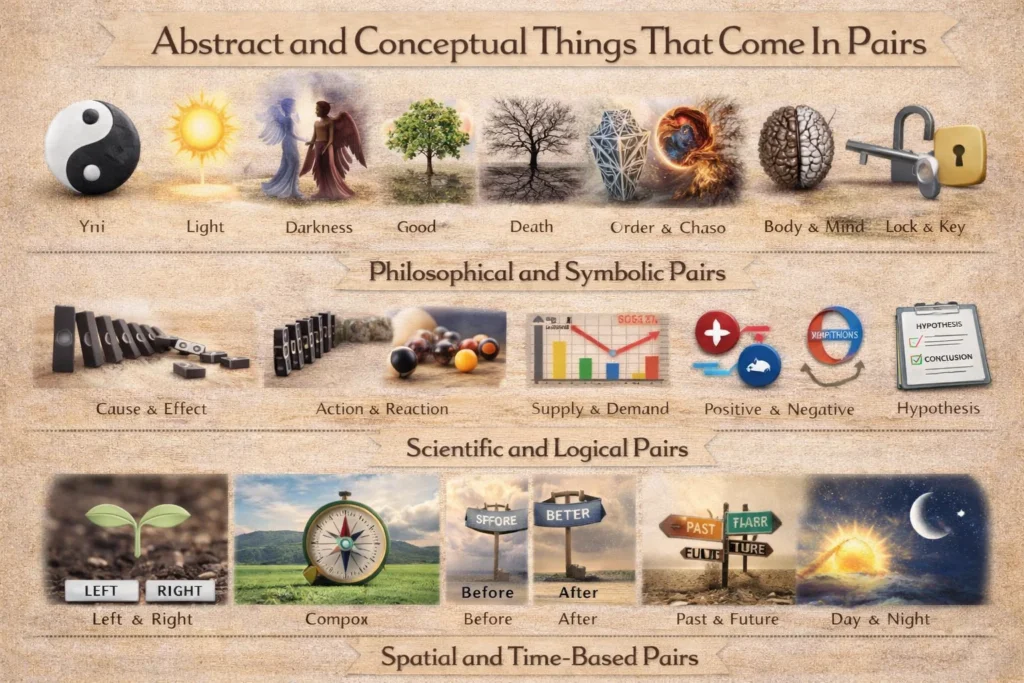
This is where the idea of pairs becomes genuinely philosophical, and it is a dimension that most lists completely ignore.
Philosophical And Symbolic Pairs
Yin and yang, light and darkness, good and evil, life and death, order and chaos, body and mind, question and answer, and lock and key are all pairs that define each other. Neither element makes sense without its counterpart. Darkness only exists as the absence of light. A lock without a key is useless. These conceptual pairs reveal that pairing is not just physical but fundamental to how humans understand the world.
Scientific And Logical Pairs
Cause and effect, action and reaction (Newton’s Third Law of Motion), supply and demand, positive and negative electrical charge, and hypothesis and conclusion are all paired concepts at the core of science, economics, and logic.
Spatial And Time-based Pairs
Left and right, north and south, east and west, before and after, past and future, here and there, day and night, and above and below are the navigational and temporal pairs that structure how humans experience space and time.
Pairs in Language: Idioms and Irreversible Word Pairs
Language itself is full of pairs, and some of them are locked in a specific order that English speakers follow without even realizing it.
English idioms about pairs include:
“Two peas in a pod” (two people who are very similar), “two sides of the same coin” (two things that seem different but are closely related), “it takes two to tango” (both parties share responsibility), and “two heads are better than one” (collaboration improves results).
Irreversible Binomials: Word Pairs That Never Swap
Irreversible binomials are paired phrases where the word order is fixed by convention. English speakers always say these in a specific sequence:
- Bread and butter (never butter and bread)
- Black and white (never white and black)
- Salt and pepper (never pepper and salt)
- Day and night (never night and day, in most contexts)
- Trial and error (never error and trial)
These frozen pairs are a fascinating quirk of language. The order is usually determined by rhythm, vowel sounds, or the order in which humans encounter the two things.
The Master List: 100+ Things That Come In Pairs
Here is your consolidated reference list, organized by type.
Single-Unit Pairs (One Object With Two Matching Parts)
Scissors, binoculars, pliers, tweezers, tongs, handcuffs, shears, clippers, forceps, sunglasses, eyeglasses, goggles, swimming fins, headphones, nunchucks, pants and trousers, shorts, jeans, tights, knitting needles (used as a pair), compasses (drawing tool), and bookends.
Two-Part Pairs (Two Physically Separate Items)
Eyes, ears, hands, feet, arms, legs, lungs, kidneys, wings, antlers, shoes, boots, gloves, mittens, socks, stockings, earrings, cufflinks, contact lenses, ski poles, ski boots, boxing gloves, shin guards, kneepads, wrist guards, drumsticks, maracas, castanets, claves, stereo speakers, earbuds, curtains, pillowcases, bedside lamps, bookends (as décor), dumbbells, crutches, chopsticks, windshield wipers, headlights, side mirrors, ski goggles (lenses), salt and pepper shakers, earplugs, knitting needles, and twins.
Surprising Pairs You Might Not Have Thought Of
- Nostrils alternate breathing dominance roughly every 90 minutes
- Cotyledons (the first paired seed leaves of nearly every flowering plant)
- Brain hemispheres that separately control language and spatial reasoning
- Double Dutch ropes (two ropes swung simultaneously in the jump rope game)
- Stereo microphones built into most smartphones
- Car wing mirrors (always two for blind spot coverage on each side)
When you feel stuck or run out of ideas, it helps to have a fresh list of inspiration ready. If you want more creative prompts beyond these, explore our 100 Creative Things to Draw When Bored for Instant Inspiration to discover new sketch ideas and keep your creativity flowing.
Conclusion: The World Really Does Work Better in Twos
From the lungs in your chest to the speakers on your desk, from chopsticks to cause and effect, pairs are woven into the fabric of biology, language, science, culture, and daily life. Bilateral symmetry made paired body parts the default design of most living things. Redundancy made two organs safer than one. Human creativity extended the principle to tools, clothing, music, and language.
Understanding things that come in pairs does more than build vocabulary. It reveals a deep pattern in how the natural world is organized and how humans have mirrored that organization in the objects they create and the words they speak.
The next time you reach for your glasses, lace up your shoes, or season your food, you are participating in one of nature’s oldest and most reliable design principles: two is almost always better than one.