
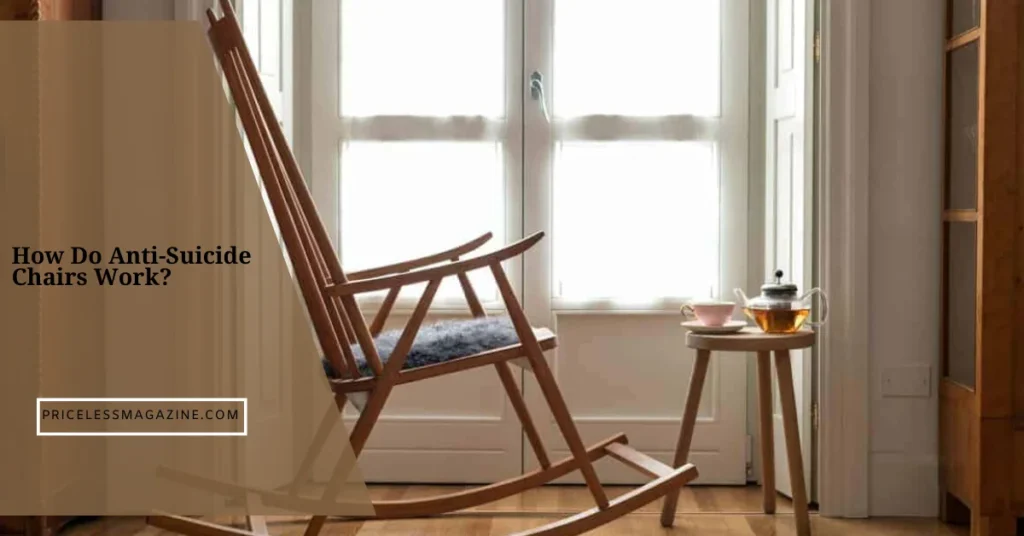

If you’ve ever spotted an oddly shaped, heavy chair in a hospital room, college dorm, or detention center and wondered what it was for, you’re not alone. Understanding how anti-suicide chairs work is important for anyone involved in mental health care, facility design, or student wellness. These chairs are not just regular furniture. Every curve, every material choice, and every missing feature is intentional.
This guide explains exactly how they work, what makes them different from normal chairs, and where they are used.
What Is an Anti-Suicide Chair?
An anti-suicide chair, also called a suicide-resistant chair, anti-ligature chair, or behavioral health chair, is a piece of furniture specially engineered to prevent self-harm in high-risk settings.
The core goal is simple: remove any feature that could be used to cause injury. That means no sharp edges, no removable parts, and crucially, no points where a rope, cord, or piece of clothing could be tied or hooked. These attachment points are called ligature points, and eliminating them is the foundation of how these chairs work.
According to research published by Kingsway Group, hanging and strangulation account for roughly 70–75% of inpatient suicide events in psychiatric care settings. Of those, over half involved a door or piece of furniture as the attachment point. That statistic alone explains why the design of a chair matters so much in these environments.
The Core Problem: What Is a Ligature Point?
Before you can understand the chair, you need to understand what it’s designed against.
A ligature is any material — a belt, shoelace, cord, or bedsheet that can be used to tie, bind, or hang. A ligature point is any physical spot where that material can be attached and held under tension. On a regular chair, ligature points are everywhere: armrests, chair legs, backrests, bolts, and frame joints.
If there’s a feature of a chair that a patient could use to harm themselves, like the arms of a chair that a bedsheet could wrap around, or a sharp corner on a table, that feature is considered a ligature point.
Anti-suicide chairs are designed from the ground up to eliminate these points entirely.
How Do Anti-Suicide Chairs Work? The Key Design Features
Here is a breakdown of every major design element and the role it plays in preventing self-harm.
1. No Sharp Edges or Corners
All edges and corners on an anti-suicide chair are rounded and smooth. There are no protruding joints, exposed bolts, or angular frames. This removes the risk of cuts and lacerations, and also eliminates anchor points that could support a ligature under tension.
2. Anti-Ligature Construction
The most critical feature is the anti-ligature design. This means:
- No gaps between the seat, back, and base where material could be threaded
- No armrests in many models, or armrests that are fully integrated into the body without gaps
- Continuous, seamless surfaces with no undercuts or recesses
- No exposed screws, bolts, or hardware — all fasteners are tamper-proof or fully recessed
Seamless construction eliminates potential hanging points and ligature attachment opportunities, while also preventing the concealment of items that loose covers might allow.
3. One-Piece Molded Construction
Many anti-suicide chairs are made from a single mold — meaning the entire seat, back, and sometimes the base are one continuous piece of material. There are no joints to exploit, no screws to remove, and no parts that can be broken off and used as a weapon.
The suicide-resistant Forte chair, for example, is formed from a one-piece, rotationally molded design using high-impact polyethylene for maximum strength. This kind of construction makes the chair extraordinarily difficult to damage or manipulate.
4. Weighted or Ballasted Base
Many anti-suicide chairs feature a weighted base — either filled with sand or made from extremely dense, heavy material. This serves two purposes:
- It prevents the chair from being picked up and thrown as a weapon
- It stops the chair from being tipped over to be used as a climbing or leverage device
Some models allow facilities to fill the base with sand themselves after delivery, adjusting the weight to match the risk level of the environment.
5. Reinforced, Durable Materials
Standard chairs use lightweight materials like thin plastic or hollow metal tubing. Anti-suicide chairs use materials specifically chosen for their resistance to damage and manipulation:
- High-impact polyethylene (HDPE) — tough, flexible, hard to crack
- Solid steel or reinforced concrete in some institutional settings
- Anti-ligature foam with specialized fire-retardant covers in softer seating
These chairs are also chemically resistant to blood, urine, salt solutions, and cleaning agents, making them practical for healthcare environments where hygiene is critical.
6. No Removable Parts
Standard chairs have cushions, leg caps, and seat covers that can be removed. Anti-suicide chairs are built so that nothing comes off. Cushioning, if present, is either molded directly into the material or fixed permanently. There are no loose pieces that could be fashioned into a tool or ligature.
Steel-encased nylon guides for floor protection are non-removable, meaning even small components that protect the floor cannot be detached and repurposed.
7. Ergonomic Comfort
A common misconception is that safety and comfort are opposites. Anti-suicide chairs are actually designed to be comfortable to sit in for extended periods. Good ergonomics matter in behavioral health settings because physical comfort can help reduce agitation and support a calmer mental state.
The chair’s contoured shape supports natural posture, reduces physical discomfort, and helps the person feel at ease — which can, in a small but real way, support their overall emotional state during a difficult time.
Types of Anti-Suicide Chairs
Not all anti-suicide chairs look the same. Different environments call for different designs.
Hard-Shell Institutional Chairs
These are the most common type in hospitals, psychiatric units, and detention centers. They are made from solid molded plastic or polyethylene, have no cushioning, and focus entirely on maximum security. They are often available in both single units and ganged versions — chairs that can be linked together in rows.
Weighted Lounge Chairs
Used in common areas of mental health facilities and behavioral health wards, these look more like standard lounge chairs but are built on a heavily ballasted base. They are often upholstered with anti-ligature fabric that has no seams or zippers.
Anti-Ligature Rocking Chairs
Chairs like the RockSmart rocking chair offer solace and aesthetic appeal in communal areas of mental health facilities. They provide the calming motion of a rocking chair while being designed to eliminate any hanging points or ligature risks. The rocking mechanism is low-to-the-ground and fully enclosed.
Dorm-Style Safety Chairs
Found in college and university residences, these look like ordinary chairs but have a rocking or tilting base that prevents them from being used as a stable platform. They’re designed to be visually normal while still reducing certain self-harm risks.
Where Are Anti-Suicide Chairs Used?
These chairs are deployed wherever vulnerable individuals may be at elevated risk:
- Psychiatric hospitals and behavioral health wards — the primary setting, where patients may be in acute mental health crises
- Correctional facilities and holding cells — where suicide risk among inmates is significantly higher than in the general population
- College and university dormitories — especially in rooms housing students identified as being in distress
- Crisis intervention centers — short-term stabilization facilities for people in mental health emergencies
- Emergency room psychiatric units — waiting and observation areas where patients are assessed before admission
Do Anti-Suicide Chairs Actually Work?
This is an important question, and the honest answer is: they are one part of a larger safety system — not a standalone solution.
Even with these features, determined individuals may still find ways to harm themselves. Anti-suicide chairs are a harm-reduction tool, not a cure.
What they do accomplish is significant: they remove the most common and impulsive means of self-harm within a space, buying time for staff to intervene. Research by professionals has shown that removing access to methods of self-harm is effective in its prevention. Reducing opportunity is one of the most reliable strategies in suicide prevention.
They also serve a secondary role: their presence signals to patients and residents that the institution takes their safety and mental health seriously — which can itself be therapeutic.
The Bigger Picture: Furniture as Part of Mental Health Care
Anti-suicide chairs don’t exist in isolation. They are part of a broader approach to trauma-informed design — the idea that the physical environment of a care facility should actively support healing, not just prevent harm.
For too long, safety-focused furniture in psychiatric hospitals has been synonymous with institutional, unwelcoming designs. Today, that paradigm is shifting — prioritizing suicide prevention no longer has to mean sacrificing comfort, aesthetics, and the human experience.
Modern anti-ligature furniture is designed to look normal — even warm — so that patients feel dignity rather than confinement. This matters because a person’s environment directly influences their emotional state and recovery outcomes.
FAQS
Find answers to the most common questions
What is a ligature point on a chair?
A ligature point is any spot on a chair such as an armrest gap, exposed bolt, or sharp frame corner where a cord or material could be tied and used to cause self harm.
Are anti suicide chairs only used in hospitals?
No. They are used in psychiatric hospitals, prisons, detention centers, college dorms, and crisis intervention centers where people at elevated risk may be present.
Can a regular chair be dangerous in a mental health setting?
Yes. Standard chairs have multiple ligature points, removable parts, and sharp edges that can pose serious risks in acute mental health situations.
What material are anti suicide chairs made from?
Most are made from high impact polyethylene, solid steel, or reinforced concrete chosen for strength, durability, and resistance to tampering.
Do anti suicide chairs look different from regular chairs?
Newer models are designed to look as normal as possible and blend into everyday environments without drawing attention to their safety purpose.
Are anti suicide chairs comfortable?
Yes. Modern designs focus on ergonomic comfort to support both physical ease and emotional calm.
Conclusion
Anti-suicide chairs work by removing every feature that could be used to cause harm — sharp edges, removable parts, attachment points, and unstable bases. Every design decision, from the single-mold construction to the weighted base, serves a clear safety purpose.
They are not a magic solution, but they are a meaningful one. Used alongside proper staffing, mental health support, and therapeutic environments, they form an important part of the safety net that protects people during their most vulnerable moments.