
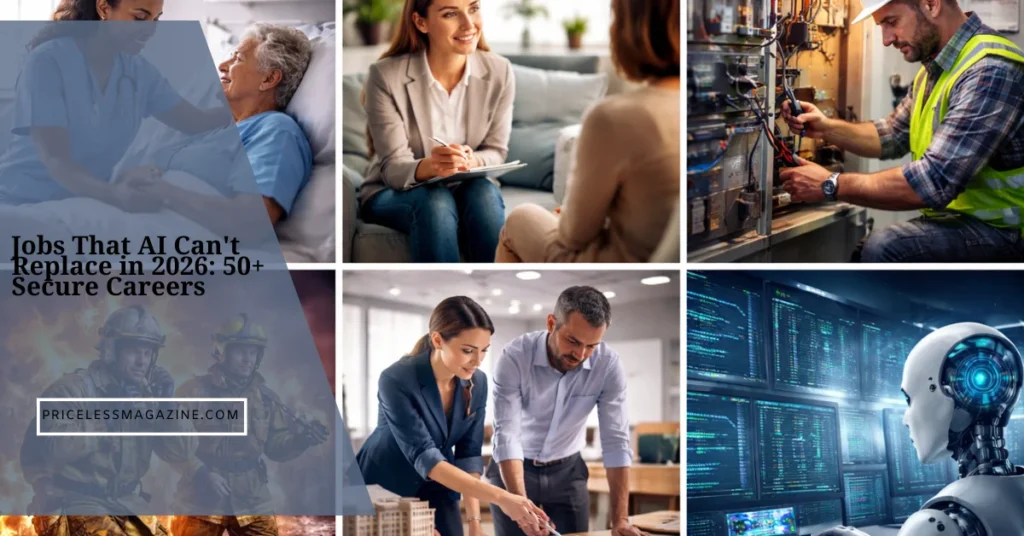

Here is the direct answer: the jobs that AI can’t replace are those that require genuine human empathy, physical judgment in unpredictable environments, licensed moral accountability, and original creative intuition. AI is fast, accurate, and relentlessly improving. But it cannot hold a grieving patient’s hand, diagnose a misfiring engine by sound alone, or defend someone in a courtroom with the full weight of human consequence on the line.
This article gives you the full picture. You will find 15 deeply explained AI-resistant careers, a quick-reference table of 50 more, the skills that make any worker harder to replace, and honest career planning advice.
If you are worried about your job, that concern is legitimate. But the data tells a more hopeful story than most headlines suggest.
What the Data Actually Says About AI and Job Replacement
The World Economic Forum’s Future of Jobs Report projects 170 million new roles created globally by 2030, alongside 92 million displaced. Goldman Sachs estimates 300 million jobs will be impacted by AI in some form. But impacted does not mean eliminated.
There is a critical distinction that almost every conversation about AI and jobs misses. Task-level automation is not the same as full-role replacement. A nurse who uses an AI triage tool has been impacted. She has not been replaced. The AI handles documentation and risk flagging. She handles the patient.
A 2024 Microsoft Copilot study tracking 200,000 anonymized users over nine months found that in complex roles, AI consistently increased reliance on human judgment rather than reducing it. The more AI handled structured, repetitive work, the more valuable human decision-making became for everything else.
Erik Brynjolfsson, a Stanford University economist, put it clearly: “I do not think we will see mass unemployment. But I do think we will see mass disruption, where wages for some jobs will fall, wages for others will rise, and we will be shifting into demand for different kinds of skills.”
That shift is already underway. Understanding which side of it you want to be on starts with knowing which roles AI genuinely cannot take over.
The Four Human Qualities That Make a Job AI-Resistant
Before diving into specific roles, it helps to understand why certain jobs resist automation. Every career on this list is protected by at least one of four core human qualities that AI still cannot replicate reliably.
- Emotional intelligence is the ability to read, respond to, and take responsibility for human emotion in real time. AI can simulate empathy through language, but it cannot feel accountability for the outcome of a therapeutic conversation or a bedside interaction.
- Physical dexterity in unpredictable environments is the hands-on problem-solving that happens inside a flooded crawlspace, on a buckling roof, or in a moving surgical theater. Robotics excel in controlled, repetitive factory settings. They stumble in the chaotic, never-the-same-twice settings where most skilled trades operate.
- Moral and ethical judgment underpins every licensed profession where a human being must sign off on a decision with legal consequences. A judge cannot transfer sentencing responsibility to an algorithm. A doctor cannot hand liability for a diagnosis to a machine. Accountability requires a person.
- Original creative intuition is the ability to generate ideas that are genuinely new, culturally grounded, and emotionally resonant. AI recombines existing patterns with extraordinary speed. It does not originate meaning. A novelist, a brand strategist, or an architect working on a culturally sensitive project brings lived experience that no model has.
15 Jobs That AI Can’t Replace
Below are jobs that can’t be replaced by AI, explained with clear reasons why human skills remain essential in each role.
1. Registered Nurse
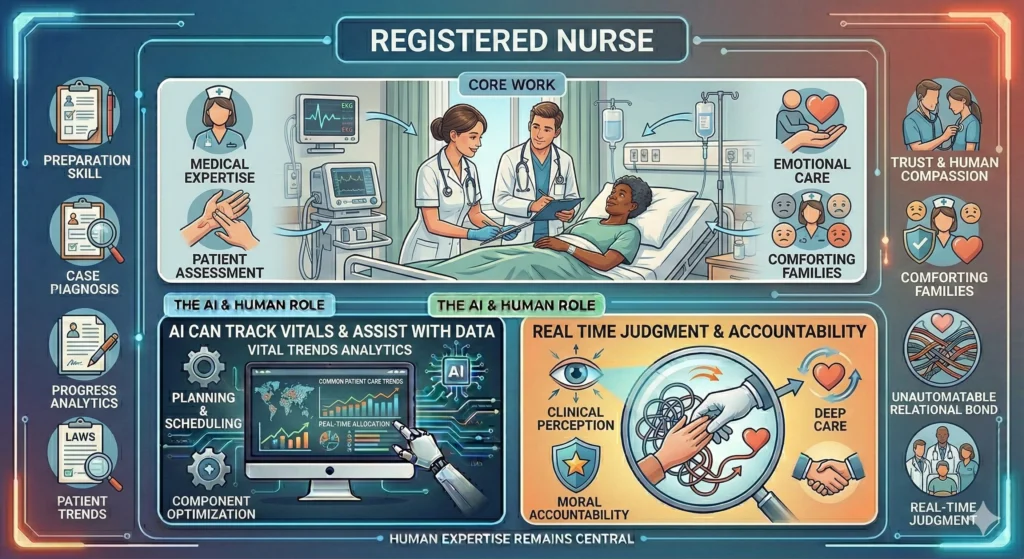
Nurses combine medical expertise with emotional care. They assess patients, respond to emergencies, and comfort families in stressful moments.
AI can track vitals and assist with data, but real time judgment, empathy, and accountability remain human responsibilities.
2. Psychotherapist and Mental Health Counselor
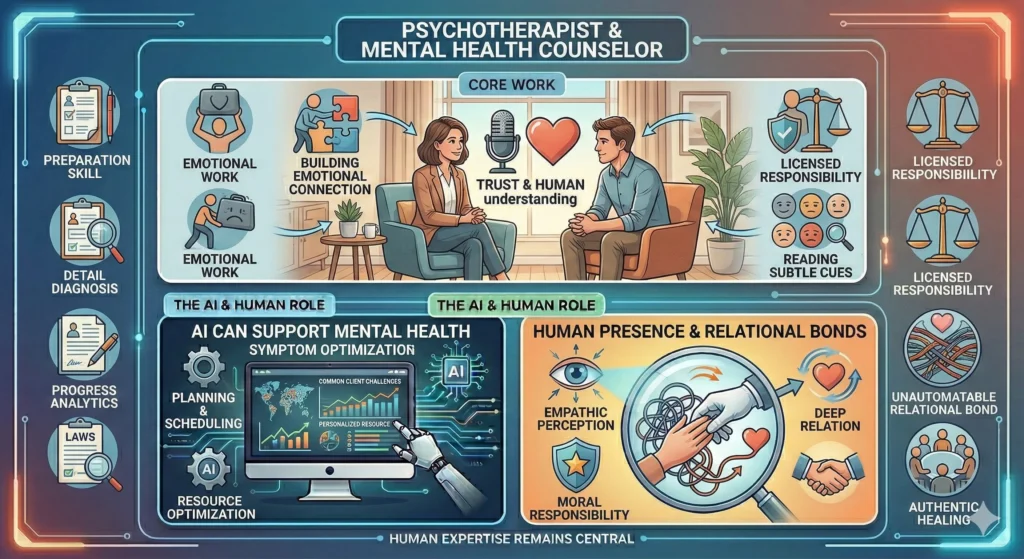
Therapy depends on trust and emotional connection built over time. Progress often comes from subtle cues and shared human understanding.
AI tools may support mental health, but licensed responsibility and deep relational bonds cannot be automated.
3. Electrician
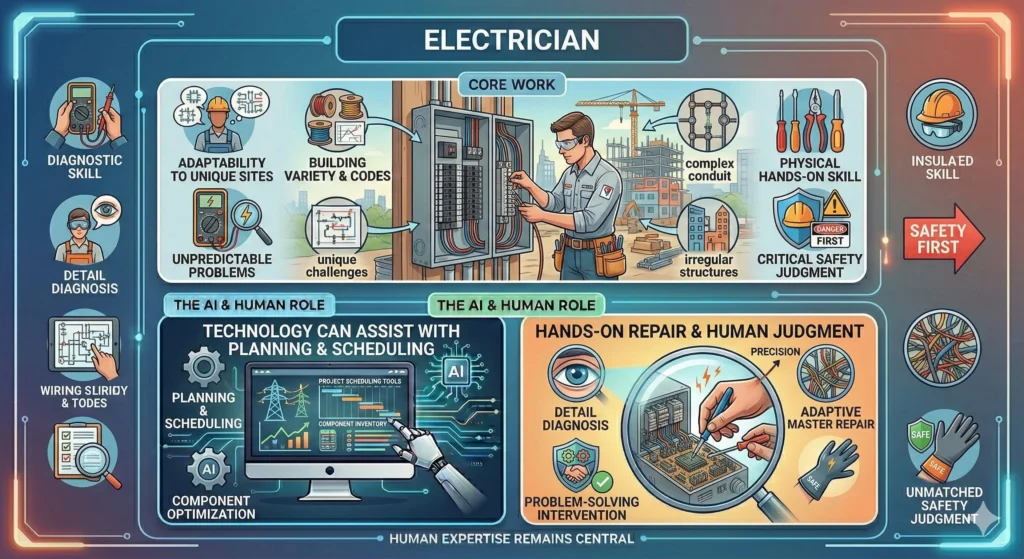
Electricians work in unpredictable environments that require physical skill and problem solving. Every building presents unique challenges.
AI can assist with planning and scheduling, but hands on electrical repair requires human adaptability and safety judgment.
4. Early Childhood Educator
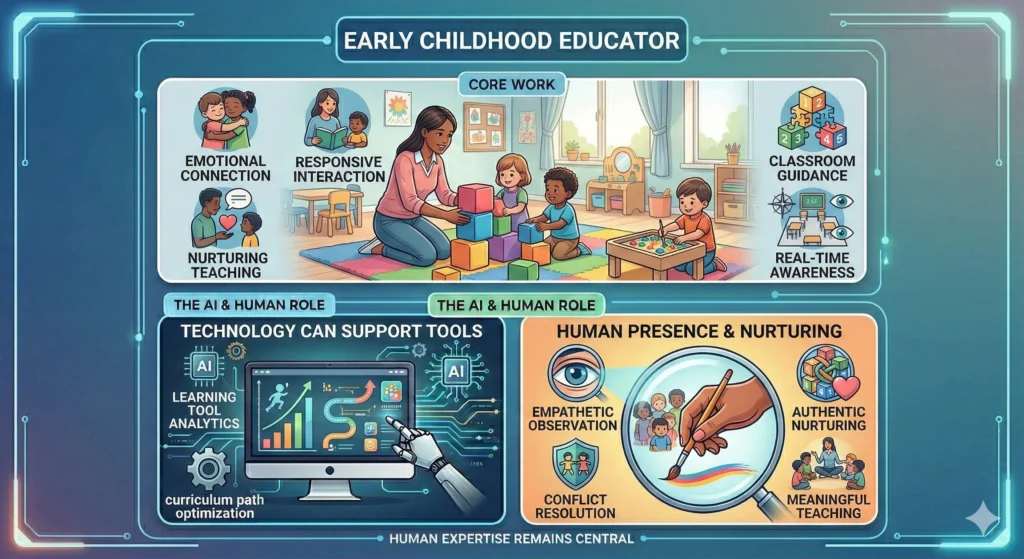
Young children learn through emotional connection and responsive interaction. Classrooms require real time awareness and guidance.
Technology can support learning tools, but nurturing, teaching, and conflict resolution rely on human presence.
5. Trial Lawyer
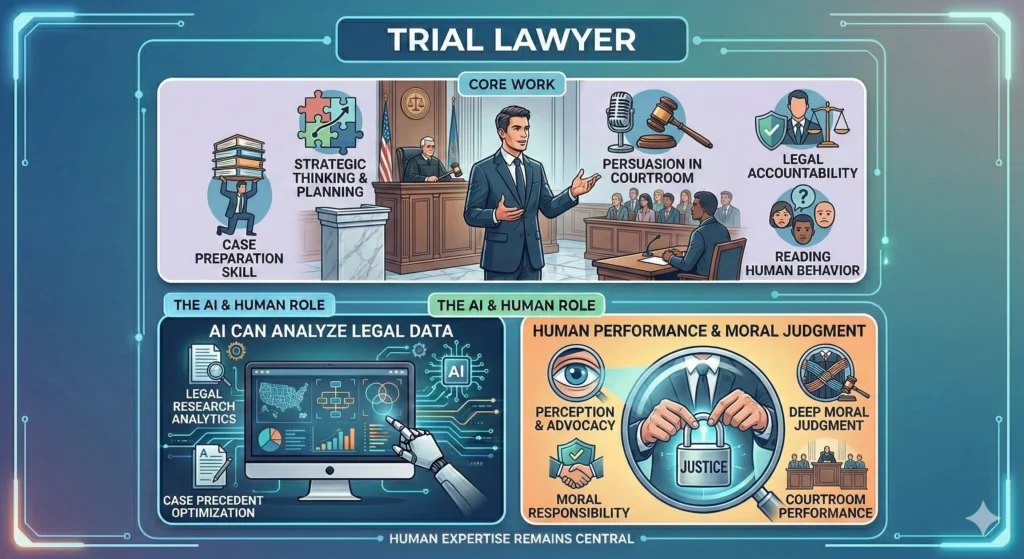
Courtroom litigation requires persuasion, strategic thinking, and reading human behavior. Legal accountability also rests with licensed professionals.
AI helps with research, but courtroom performance and moral judgment remain deeply human.
6. Surgeon
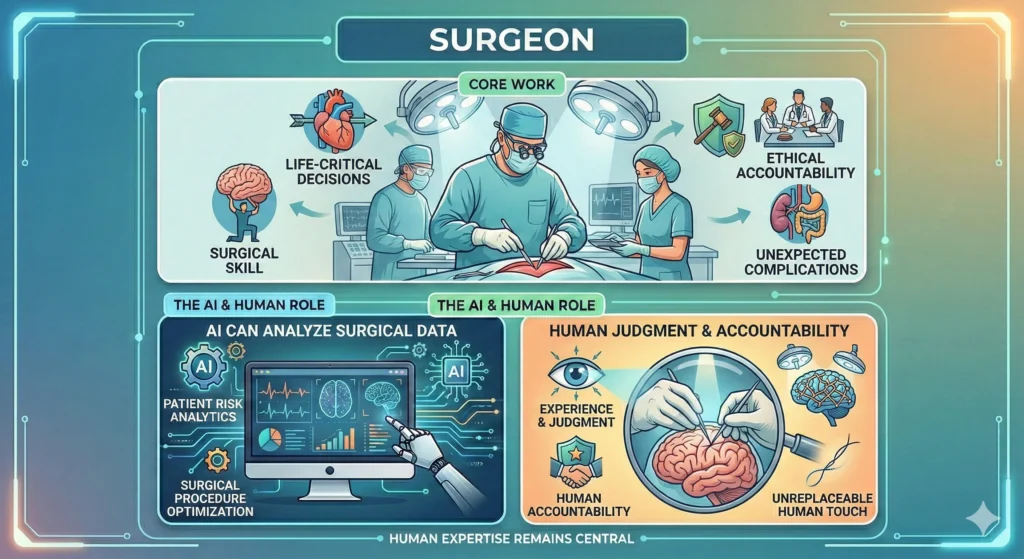
Surgeons make life critical decisions during procedures. Even robotic systems operate under human supervision.
Unexpected complications require experience, judgment, and accountability that machines cannot replace.
7. Social Worker
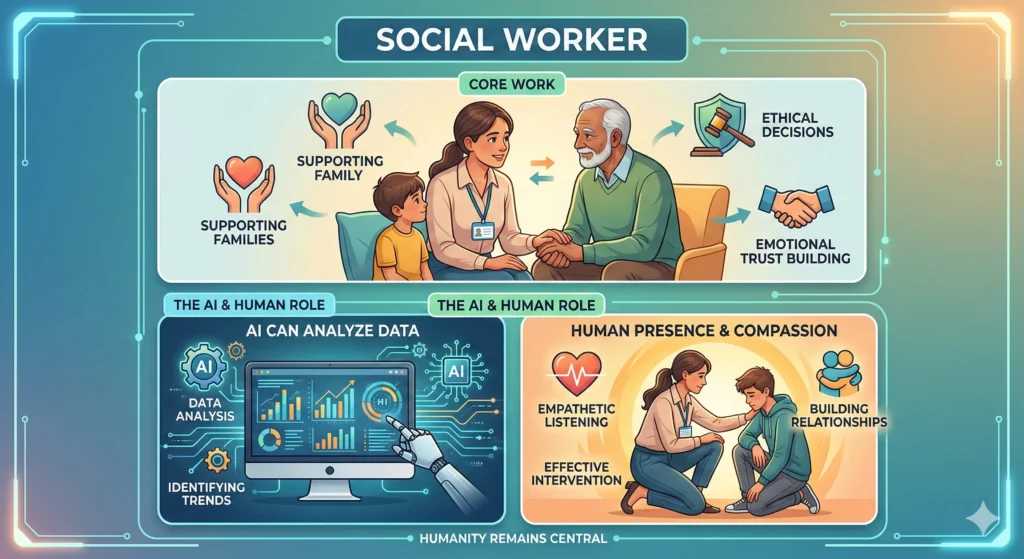
Social workers support families and individuals in crisis. Their work involves ethical decisions and emotional trust building.
AI can analyze data, but human presence and compassion remain central to effective intervention.
8. Plumber
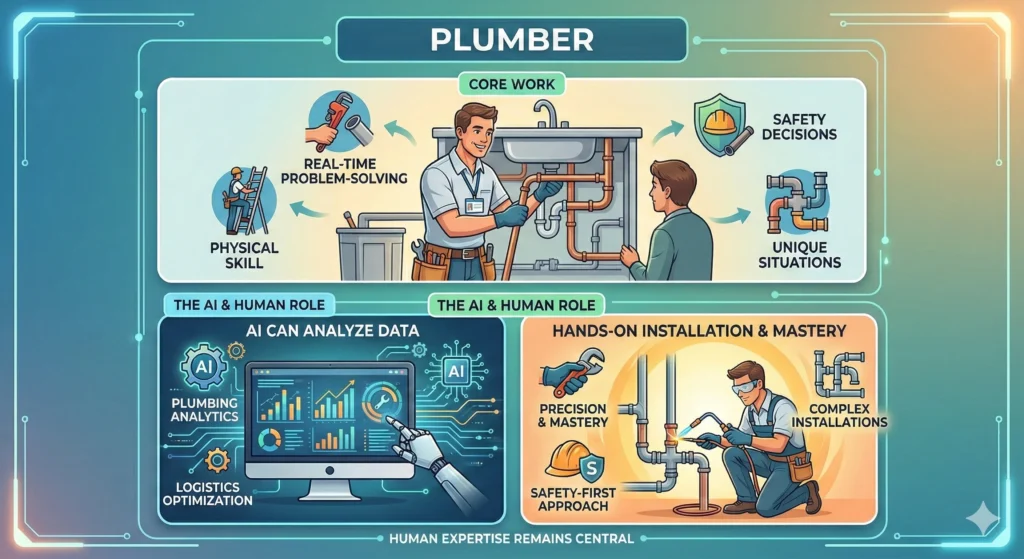
Plumbing requires physical skill and real-time problem-solving in varied environments. Each repair situation is unique.
While AI can help with logistics, hands-on installation and safety decisions must be human-led.
9. Physical Therapist
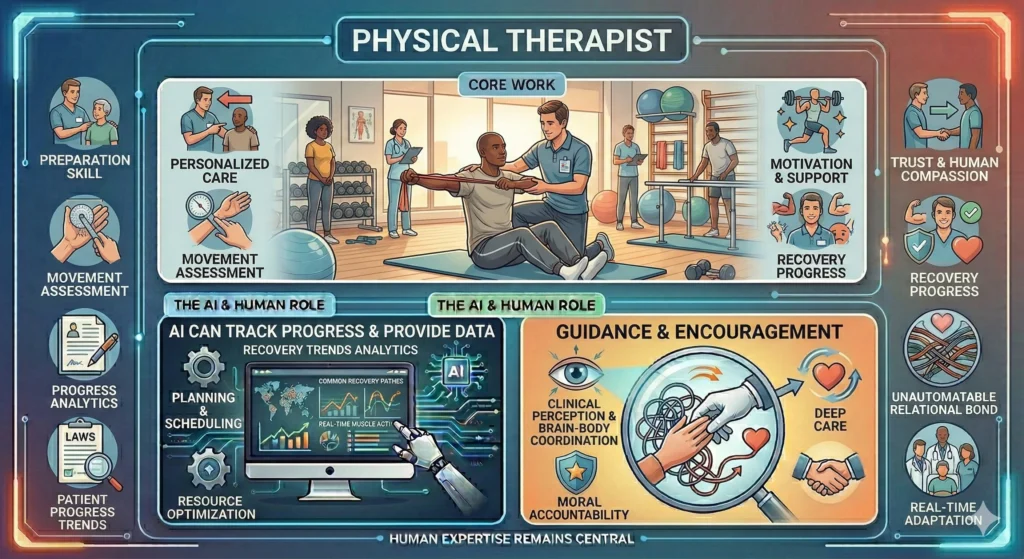
Recovery depends on personalized care and motivation. Therapists adjust exercises based on subtle patient feedback.
AI supports tracking progress, but guidance and encouragement remain human strengths.
10. Wind Turbine Service Technician
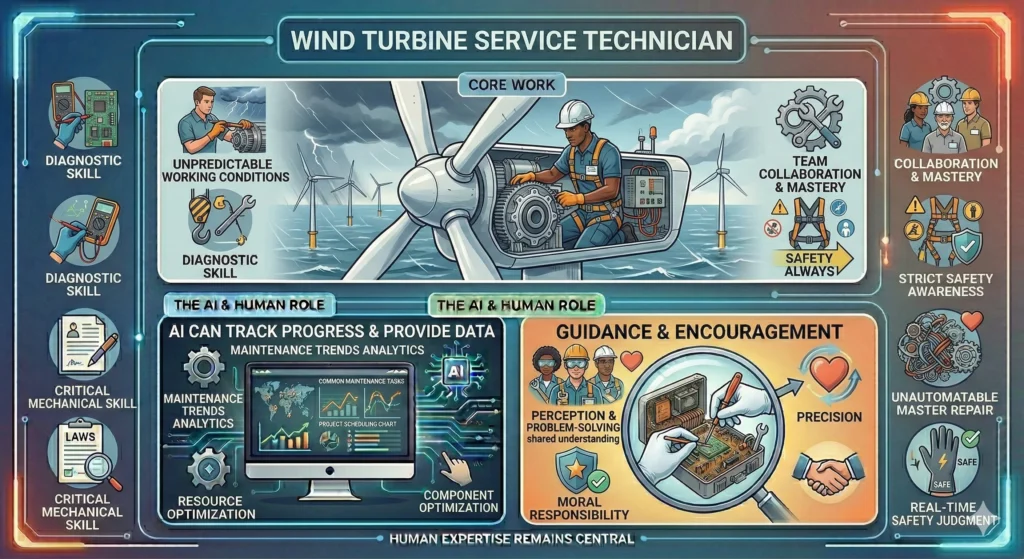
This role involves working at heights in changing weather conditions. It combines mechanical skill with strict safety awareness.
The physical and environmental complexity makes full automation impractical.
11. Occupational Therapist
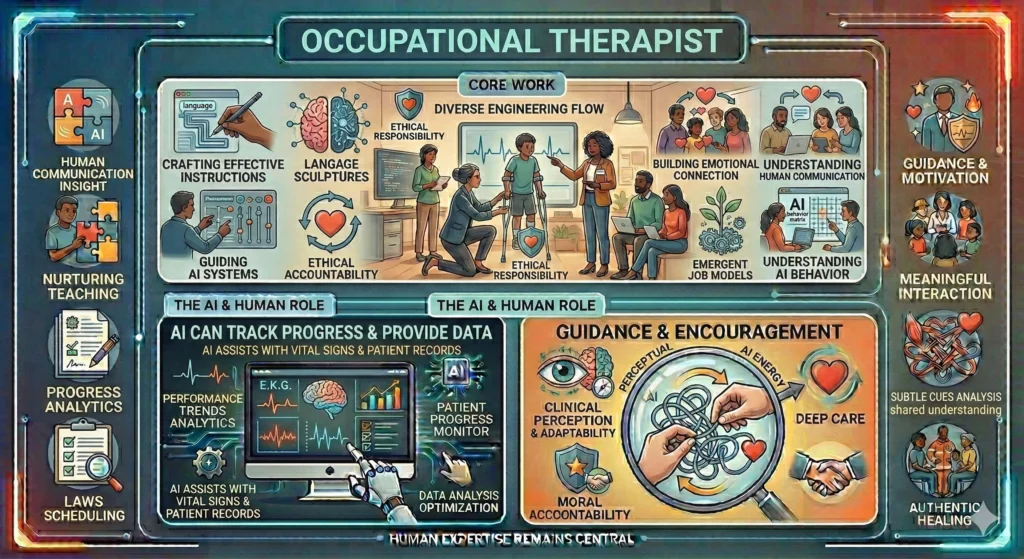
Occupational therapists tailor recovery plans to each person’s daily life and emotional needs.
Human insight and relationship building are critical to long term progress.
12. School Psychologist
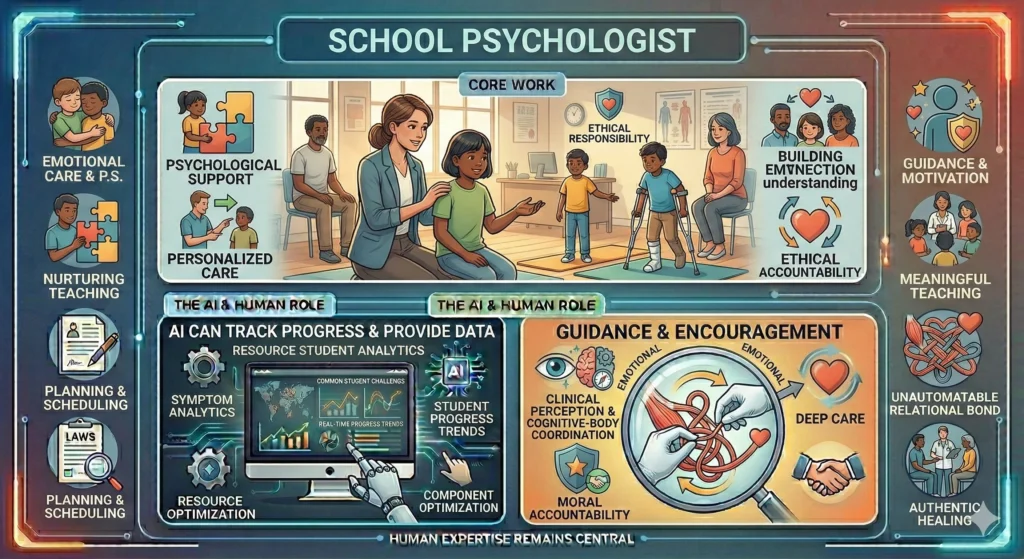
School psychologists guide students through academic and emotional challenges. Their assessments shape educational paths.
The ethical weight and personal interaction involved cannot be delegated to software.
13. Firefighter
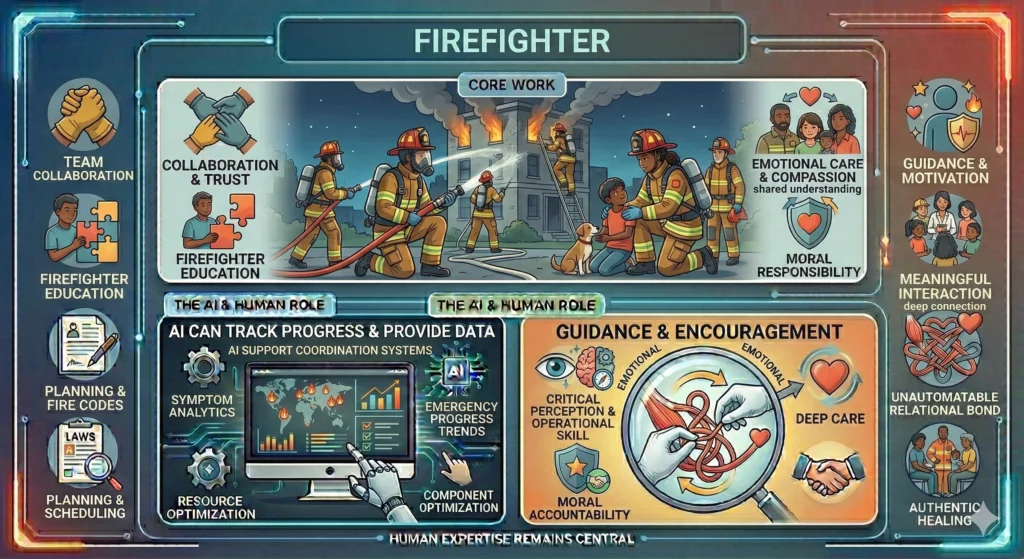
Firefighters operate in unpredictable, high risk environments. Decisions must be made instantly under pressure.
AI supports coordination systems, but rescue and life saving actions require human courage and adaptability.
14. Architect
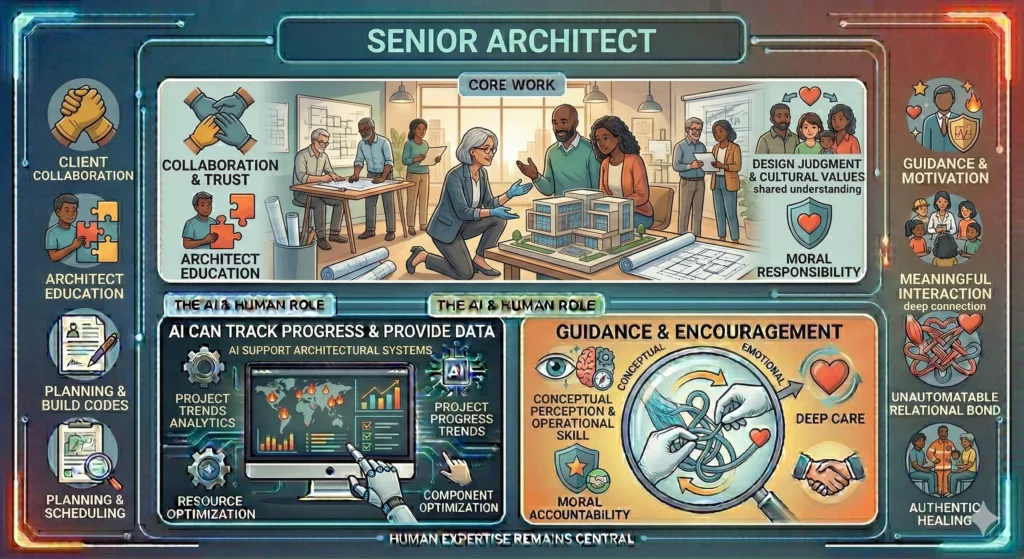
Senior architects design spaces that reflect human needs and cultural values. Creative judgment plays a central role.
AI assists with drafting, but conceptual vision and client collaboration remain human driven.
15. Prompt Engineer
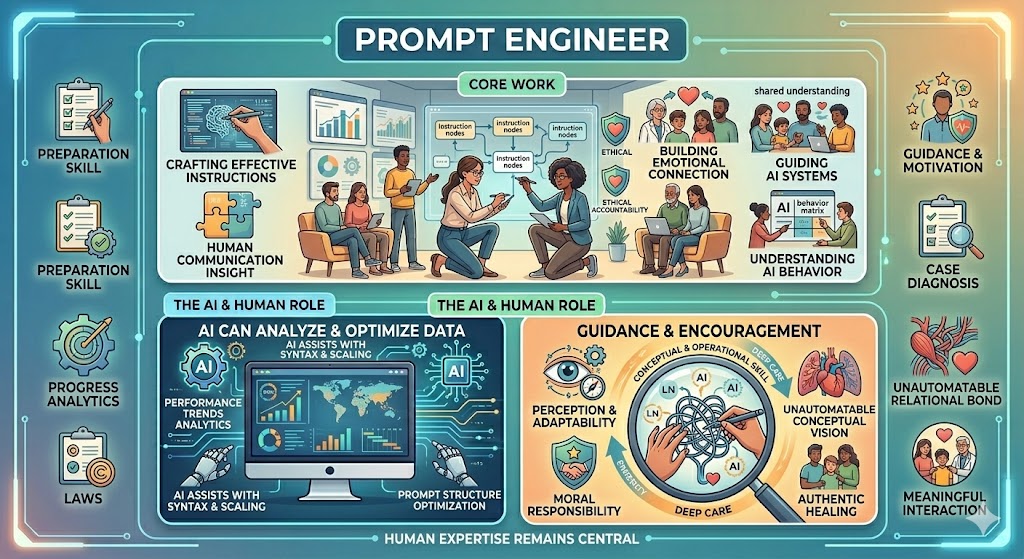
Prompt engineers guide AI systems by crafting effective instructions. This role depends on understanding both human communication and AI behavior.
It demonstrates how new jobs are emerging that require human judgment even within the AI economy.
Quick Summary: What All These Jobs Have in Common
Every role above shares at least one of these characteristics:
- Requires licensed human accountability with legal consequences
- Operates in physically unpredictable or emotionally complex environments
- Depends on trust built through authentic human presence over time
- Involves moral judgment that cannot be delegated to a system
- Requires original human creativity grounded in lived experience and cultural context
Understanding these patterns helps you evaluate any career, including your own, through the lens of automation resilience.
50 Additional Jobs That AI Can’t Replace (Quick Reference Table)
| Job Title | Key Reason AI Can’t Replace It |
|---|---|
| Hospice Nurse | End-of-life emotional presence |
| Paramedic / EMT | Real-time physical crisis response |
| Dental Hygienist | Manual dexterity and patient trust |
| MRI Technologist | Patient positioning and emotional reassurance |
| Surgical Technologist | Sterile technique and real-time adaptability |
| Marriage and Family Therapist | Relational trust and ethical accountability |
| Substance Abuse Counselor | Empathy and lived-experience credibility |
| Crisis Intervention Specialist | Real-time emotional de-escalation |
| Community Health Worker | Cultural trust and interpersonal navigation |
| Chaplain / Bereavement Counselor | Human grief support, spiritual presence |
| Special Education Teacher | Individualized human responsiveness |
| Speech-Language Pathologist | Personalized communication therapy |
| Instructional Coach | Mentorship and relational feedback |
| University Professor (Research) | Original inquiry and intellectual leadership |
| HVAC Technician | Physical complexity, varied environments |
| Welder | Precision physical skill, safety judgment |
| Elevator Installer | Safety-critical, site-specific physical work |
| Industrial Machinery Mechanic | Unpredictable mechanical environments |
| Carpenter | Creative problem-solving in physical space |
| Diesel Mechanic | Sound and tactile diagnosis skills |
| Masonry / Bricklayer | Physical craft, irreplaceable precision |
| Construction Manager | Human coordination and site judgment |
| Solar Panel Installer | Physical installation, site variation |
| Environmental Scientist | Field research, natural system complexity |
| Conservation Scientist | Ecological judgment, physical fieldwork |
| Climate Policy Analyst | Systems thinking and political judgment |
| Judge / Magistrate | Legally mandated human accountability |
| Criminal Defense Attorney | Courtroom strategy and moral advocacy |
| Forensic Scientist | Physical evidence handling and expert testimony |
| Probation Officer | Human behavioral assessment |
| Compliance and Ethics Officer | Moral reasoning and regulatory navigation |
| Brand Strategist | Cultural intuition and creative direction |
| Film Director | Human storytelling and emotional vision |
| Novelist / Literary Author | Original narrative voice and lived experience |
| Art Director | Aesthetic judgment and creative leadership |
| UX Researcher | Human empathy and behavioral observation |
| Executive / CEO | Organizational judgment and human leadership |
| Human Resources Manager | Interpersonal conflict resolution |
| Operations Manager | Adaptive human coordination |
| Organizational Psychologist | Behavioral insight and cultural change |
| Firefighter Captain | Real-time command in life-threatening situations |
| Police Detective | Human interrogation and contextual reasoning |
| Search and Rescue Specialist | Physical response in uncontrolled environments |
| Funeral Director | Grief support and ceremonial presence |
| Clergy / Religious Leader | Spiritual guidance and community trust |
| Personal Trainer | Motivation, accountability, and body knowledge |
| AI Ethics Officer | Moral governance of AI systems |
| AI Trainer / Data Curator | Human-defined ground truth for AI models |
| Human-AI Interaction Designer | Empathy-centered interface design |
| MLOps Engineer | Production AI system oversight and diagnosis |
How to Future-Proof Your Career in the Age of AI
Knowing which jobs are safe is only half the equation. The other half is understanding what you can do to increase your own career resilience, regardless of your current role.
- Audit your daily tasks honestly. List the ten things you do most frequently at work. For each one, ask: does this require human judgment, physical presence, emotional intelligence, or ethical accountability? Or is it primarily data-based and repetitive? The tasks in the second category are the ones to watch. The tasks in the first category are your strengths to develop.
- Invest in your highest-resilience skills. If you are in healthcare, deepen your clinical judgment and patient communication. If you are in trades, pursue advanced certification. If you are in leadership, build your capacity for organizational psychology and conflict resolution. These skills grow more valuable as AI handles more of the cognitive baseline.
- Add AI literacy to whatever you already do. You do not need to become a programmer. You need to understand what AI tools do in your field, when to trust the output, and when to override it. The workers most at risk in coming years are not necessarily those in vulnerable roles. They are those in any role who refuse to develop fluency with the tools that are reshaping their profession.
- Consider the adjacent AI-resistant move. If you are currently in a role that appears on the declining jobs list, identify the nearest AI-resistant field that uses your transferable skills. A bookkeeping clerk who develops healthcare billing expertise moves into a far more protected role. An administrative secretary who builds operations management competency moves into judgment-intensive work that AI cannot replicate.
Frequently Asked Questions
Find answers to the most common questions
Will AI eventually replace all jobs, including the ones on this list?
No. Most research shows AI will reshape jobs, not eliminate all of them. Roles that rely on emotional intelligence, accountability, and complex human judgment remain highly protected.
What percentage of jobs will AI replace by 2030?
Estimates suggest around 25 to 30 percent of roles may face significant automation exposure. However, many jobs will transform rather than disappear, and new roles will continue to emerge.
Is it too late to switch to an AI resistant career?
No. Many AI resistant careers in healthcare, skilled trades, and clean energy offer accessible training paths through certifications and apprenticeships.
What single skill makes a worker hardest to replace by AI?
Emotional intelligence combined with professional accountability is the strongest protection. Human responsibility and trust are difficult to automate.
Are creative jobs safe from AI?
Entry level creative tasks are increasingly automated, but strategic creative direction and culturally grounded storytelling remain deeply human.
What new jobs is AI creating?
Emerging roles include prompt engineer, AI trainer, ethics specialist, and human AI interaction designer. These positions are growing rapidly in demand.