
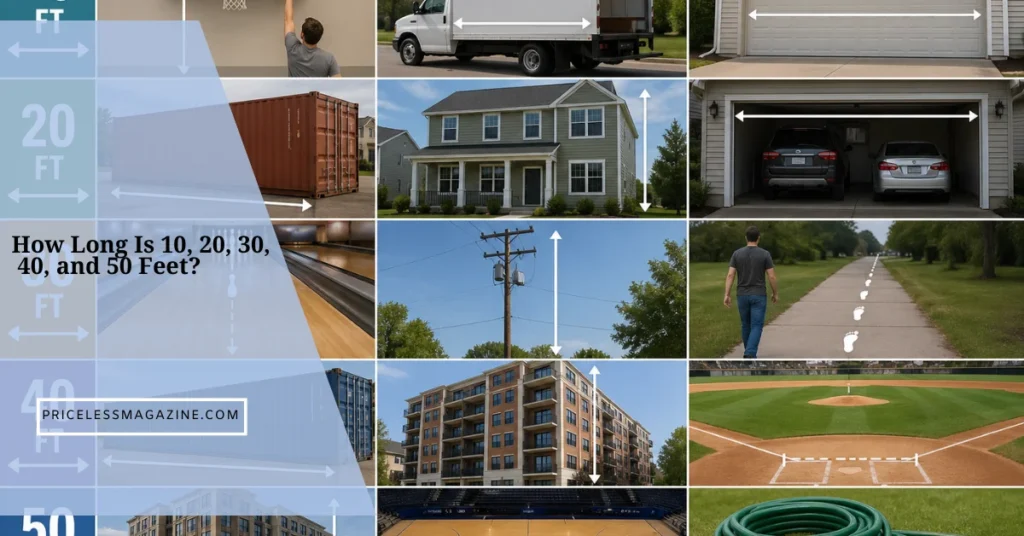

Feet-scale measurements are harder to picture than inches because you cannot hold the references in your hand. You have to stand inside them, drive past them, or look up at them. That shift in how you experience the size is exactly why most people struggle to picture 30 feet versus 40 feet — both sound large in the abstract but feel completely different once you connect them to something familiar.
This page covers exactly five measurements — 10, 20, 30, 40, and 50 feet. Nothing in between. Every reference object below is confirmed at that specific measurement or given an honest range where variation exists. Two common wrong references that appear widely across other measurement sites are corrected here so you do not build your mental picture around something that does not actually measure what it claims.
Each measurement gets three confirmed references drawn from different categories — structures, vehicles or regulated objects, and a practical estimation method you can use on the spot without any tools.
Quick conversions
10 ft
3.05 meters / 120 inches
30 ft
9.14 meters / 360 inches
50 ft
15.24 meters / 600 inches
How long is 10 feet?
Ten feet is the measurement that defines indoor ceiling height and single-car garage width in the United States. It sits at roughly twice the height of an average adult — tall enough to feel open and spacious inside a room, short enough to feel reachable when you look up at it.

The rim of a regulation basketball hoop sits exactly 10 feet above the floor. This standard was set when Dr. James Naismith invented the game in 1891 — the peach basket he nailed to a running track balcony happened to be 10 feet off the ground — and it has not changed in over 130 years. Every NBA, FIBA, NCAA, and high school court uses this same height. If you have ever stood directly beneath a basketball hoop and looked up at the rim, you have experienced exactly 10 feet above you. That gap between the top of your reach and the rim is why the game requires skill rather than just height.

The smallest moving truck in the U-Haul fleet — the one marketed for studio apartments and small moves — has a cargo box measuring exactly 10 feet in length. This is the box portion of the truck from the rear door to the cab wall, not the full vehicle length which is longer. U-Haul publishes this specification explicitly. If you have ever rented or seen one of these compact moving trucks on the road, the cargo box from rear door to front wall is your exact 10-foot reference. Most people are surprised by how much space 10 feet actually contains once they stand inside one.

A standard single-car garage door is 9 to 10 feet wide, with 10 feet being the most common width in U.S. residential construction. This width is designed to give a typical passenger vehicle comfortable clearance on both sides during entry and exit. A standard residential ceiling in homes built after 1990 also measures 9 to 10 feet from floor to ceiling — older homes built before 1970 more commonly have 8-foot ceilings. If you live in a home with what feels like a generous ceiling height, stand in that room and look up — you are looking at approximately 10 feet.
Quick estimation tip: ten adult walking steps equals approximately 10 feet for most people, since an average adult step covers about 1 foot. Count ten steps in a straight line and you have covered roughly 10 feet. Confirm once against a tape measure and your step becomes a permanent reference.
How long is 20 feet?
Twenty feet is the measurement of two-story building height and two-car garage width. It is also the standard length of the most common shipping container in global trade. Once you connect 20 feet to those three references, it shifts from an abstract number to something you drive past and park inside on a regular basis.

The ISO standard 20-foot shipping container — designated TEU (Twenty-foot Equivalent Unit) in global freight — measures 19 feet 10.5 inches in external length. It is universally referred to as a 20-foot container across the shipping, logistics, and construction industries. These steel boxes are among the most standardised manufactured objects in the world, with identical external dimensions produced by factories across multiple countries. If you have ever driven past a port, a rail yard, or a construction site and seen stacked steel containers, the shorter ones are almost certainly 20-foot containers. Standing at one end and looking to the other gives you one of the most direct 20-foot experiences available.

A standard two-story residential home measures approximately 18 to 22 feet from the ground to the roofline, with 20 feet being the most common height in U.S. residential construction. This accounts for two floors of 9-foot ceiling height plus the structural floor between them. Standing at the base of a two-story home and looking up to the gutter line gives you a reliable approximation of 20 feet. This is also approximately the height of a standard outdoor residential flagpole — the most common residential flagpole sold in the U.S. is the 20-foot model, chosen because it sits visibly above a single-story roofline without requiring structural engineering.

A standard two-car garage in the United States measures 18 to 22 feet wide, with 20 feet being the most widely cited standard in residential construction guidelines. This width allows two average-sized vehicles to park side by side with enough door-swing clearance on each side to exit the vehicles comfortably. If you have ever parked two cars in a standard American garage, you have stood inside a 20-foot-wide space. The 20-foot extension ladder — the most common size used by professional contractors for two-story work — is also exactly 20 feet at full extension, providing a vertical reference for anyone who has watched roofers or painters work on a standard suburban home.
Quick estimation tip: two average mid-size sedans parked bumper to bumper cover approximately 28 to 32 feet combined — more than 20 feet. A single full-size pickup truck is approximately 19 to 20 feet long, making it one of the most accessible single-vehicle references for this measurement. If you drive or regularly park next to a full-size truck, its length is your reference.
Common correction: a full-grown giraffe is frequently listed as a 20-foot reference. Adult giraffes stand 16 to 18 feet tall — not 20 feet. The tallest recorded giraffe measured 19.3 feet, which is an outlier rather than a typical adult height. Use a two-story building or a 20-foot shipping container as your reference instead.
How long is 30 feet?
Thirty feet is a measurement most people encounter outdoors more than indoors — utility poles, three-story buildings, and the halfway point of a bowling lane all sit at or near this distance. It feels like a significant length when you are standing on the ground looking at it vertically, and surprisingly walkable when you cover it horizontally.

A regulation bowling lane from the foul line to the head pin measures exactly 60 feet — this is a fixed specification set by the United States Bowling Congress that applies to every sanctioned lane in the country. Half of that distance is exactly 30 feet. When you stand at the foul line and look toward the pins, the midpoint of the lane — roughly where the lane arrows and dots end — is 30 feet away from you. For anyone who has bowled even a few times, that distance between the foul line and the approximate middle of the lane is one of the clearest horizontal 30-foot references available indoors.

A standard residential utility or telephone pole is typically 35 to 40 feet in total length, with approximately 6 feet buried below ground and 30 to 35 feet remaining above it. The Class 5 and Class 6 poles most commonly installed in residential neighborhoods across the U.S. leave 30 feet of pole visible above the street. Standing at the base of a utility pole on your street and looking up to the cross-arms and transformer gives you a consistent 30-foot vertical reference that appears on almost every residential block in the country. A three-story building sits at approximately 30 to 33 feet tall, providing the same vertical reference in built environments.

The average adult walking step covers approximately 2.5 to 3 feet — with the higher end of that range applying to taller adults with a longer natural stride. Ten normal walking steps cover approximately 25 to 30 feet for most adults, with ten steps landing closer to 30 feet for average-height adults walking at a natural pace. This is one of the most immediately useful estimation methods in this range because it requires no objects, no tools, and no comparison items — just counting steps. Confirm once against a tape measure along a driveway or hallway and your own step becomes a permanent 3-foot reference that adds up reliably to 30 feet at ten steps.
Common correction: a standard yellow school bus is frequently listed as a 30-foot reference. A full-size Type C or D school bus measures 35 to 40 feet in total length. A short Type A school bus measures 20 to 25 feet. No standard school bus model confirms at exactly 30 feet. Neither is an accurate 30-foot reference.
Quick estimation tip: three full-size pickup trucks parked bumper to bumper cover approximately 57 to 60 feet — exactly two of them is your closest vehicle-based reference for 30 feet, at approximately 38 to 40 feet combined. The bowling lane midpoint and the utility pole height are more precise for 30 feet specifically.
How long is 40 feet?
Forty feet is the length of the most common shipping container in global freight, the height of a four-story building, and just under half the distance of a standard baseball infield baseline. It is the measurement where most people start to lose their spatial intuition — 40 feet feels large but not enormous, long but not endless.

The ISO standard 40-foot shipping container — the most common container size in global freight by volume — measures exactly 40 feet in external length. While the 20-foot container is more common in port photography and urban repurposing projects, the 40-foot container accounts for the majority of cargo transported by sea. These containers are manufactured to identical specifications worldwide. Standing at one end of a 40-foot container and walking to the other is one of the most precise 40-foot experiences you can have without a tape measure. Many of the large steel containers you see stacked on freight trains passing through residential areas are 40-foot units.

A standard four-story commercial or residential building measures approximately 40 to 44 feet in total height from ground to roofline. This is based on standard floor-to-floor heights of approximately 10 feet per level in commercial construction. Many urban mid-rise apartment buildings in the 4-story category confirm this range. Standing at the base of a four-story building and looking up to the roofline gives you a reliable 40-foot vertical reference in any city center or dense residential neighborhood. This height is also significant in U.S. fire code — many fire department aerial ladders have a maximum reach of 75 to 105 feet, with 40 feet representing the lower end of mid-rise building height.

A regulation MLB baseball diamond has baselines of exactly 90 feet from base to base. Forty feet represents 44% of a single baseline — roughly the distance from home plate to a point just past the pitcher’s mound when approaching first base. The pitcher’s rubber itself sits 60.5 feet from home plate, so 40 feet puts you between home plate and the mound from the batter’s perspective. For anyone who has played or watched baseball from field level, picturing that distance from the batter’s box toward the pitcher gives a familiar horizontal reference for 40 feet. It is far enough to feel like a meaningful distance across a field but clearly less than halfway to first base.
Quick estimation tip: four average adult walking steps cover approximately 10 feet. Forty feet is therefore approximately 13 to 14 normal walking steps for most adults. Count fourteen steps from a starting point and you have covered roughly 40 feet. Confirm against the length of a 40-foot shipping container if you ever have access to one.
How long is 50 feet?
Fifty feet is five stories up, roughly half the width of a regulation basketball court, and the length of a standard garden hose sold at most hardware stores. It is the measurement where objects start to feel genuinely large — long enough that you need to turn your head to see from one end to the other in most indoor settings.

A standard five-story commercial or residential building measures approximately 50 to 55 feet from ground to roofline. Using the standard 10-foot floor-to-floor height in commercial construction, five floors produces exactly 50 feet. Many mid-rise office buildings, apartment complexes, and hotel structures in American cities confirm this height in the five-story category. Standing at the base of a five-story building and looking up to the roofline is one of the most immediate urban references for 50 feet. At this height, people on the roof are clearly visible but no longer appear full-size — they look noticeably smaller than at ground level, which is one of the clearest perceptual signals that you are looking at approximately 50 feet.

A regulation NBA and NCAA basketball court measures exactly 50 feet wide — the distance from sideline to sideline across the short dimension of the court. The court length is 94 feet. The 50-foot width is a fixed specification that applies to all professional and college courts in the United States. If you have ever sat in the bleachers at a basketball game and looked across the court from one sideline to the other, that width is exactly 50 feet. Standing at one sideline and looking straight across to the opposite sideline gives you one of the most precise large-scale 50-foot references available in a public indoor space.

The most common garden hose length sold at U.S. hardware and home improvement stores is 50 feet. Home Depot, Lowe’s, and Amazon all list the 50-foot hose as their primary standard length, positioned between the shorter 25-foot hose and the longer 100-foot option. A 50-foot garden hose fully uncoiled in a straight line is one of the most immediate hands-on references for this measurement because most homeowners own one. If you have ever stretched a hose from an outdoor spigot to the far edge of a front or back yard, you have personally experienced what 50 feet of length looks and feels like in your own outdoor space.
Quick estimation tip: fifty feet is approximately 17 normal adult walking steps. It is also exactly five times the height of a basketball hoop (10 feet). Standing beneath a basketball hoop and picturing five of those heights stacked vertically gives you a clear sense of how tall 50 feet actually is above you.
All five measurements compared
Placing all five measurements side by side against the same reference points shows how each one relates to the others and reveals which comparisons are most useful for building an accurate spatial sense of the full range.
| Measurement | Metric | Best confirmed reference | Floors of a building | Adult walking steps |
|---|---|---|---|---|
| 10 feet | 3.05 m | Basketball hoop rim height | 1 floor | Approx 3 to 4 steps |
| 20 feet | 6.10 m | Standard 20-foot shipping container | 2 floors | Approx 7 to 8 steps |
| 30 feet | 9.14 m | Half a regulation bowling lane | 3 floors | Approx 10 steps |
| 40 feet | 12.19 m | Standard 40-foot shipping container | 4 floors | Approx 13 to 14 steps |
| 50 feet | 15.24 m | Basketball court width / 50-foot garden hose | 5 floors | Approx 17 steps |
How each measurement relates to the others
| Comparison | Relationship | Practical meaning |
|---|---|---|
| 10 ft vs 20 ft | 20 ft is exactly double 10 ft | Two basketball hoop heights stacked equals 20 feet |
| 20 ft vs 30 ft | 30 ft is 1.5x the length of 20 ft | A 20-ft container plus one 10-ft room equals 30 feet |
| 10 ft vs 40 ft | 40 ft is exactly four times 10 ft | Four single-car garage door widths end to end |
| 20 ft vs 40 ft | 40 ft is exactly double 20 ft | Two 20-foot shipping containers end to end |
| 10 ft vs 50 ft | 50 ft is exactly five times 10 ft | Five basketball hoop heights stacked equals 50 feet |
| 30 ft vs 50 ft | 50 ft is 1.67x the length of 30 ft | A full bowling lane is 60 ft — 50 ft is five-sixths of it |