
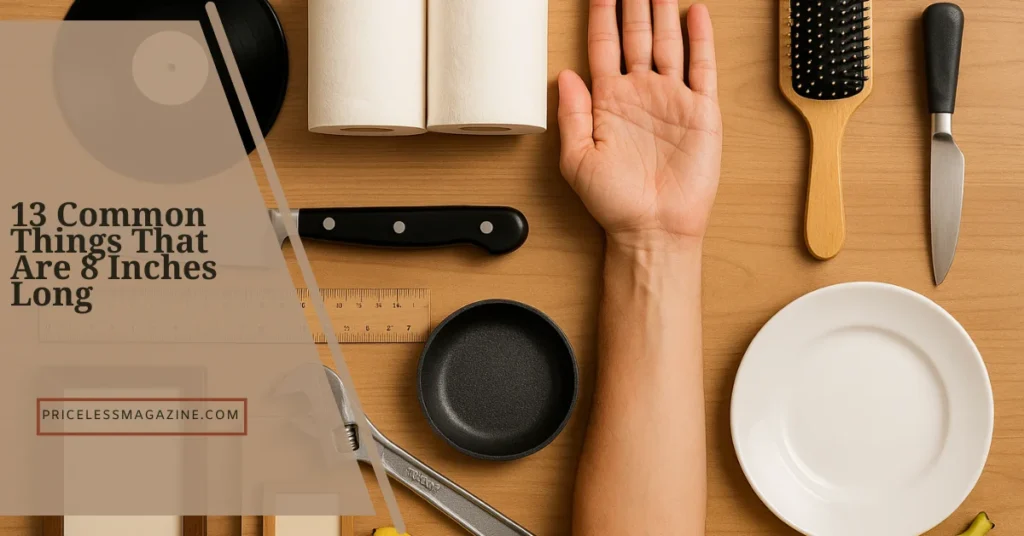

Eight inches is one of those measurements that sounds straightforward until you need to picture it without a ruler. It shows up constantly — in kitchen tools, tech specs, furniture listings, and clothing labels — yet most people have only a vague sense of what it actually looks like in their hand.
This guide walks through 13 real objects that measure at or very close to 8 inches, grouped by where you encounter them. Each entry includes the confirmed size so you know whether it is an exact match or a close reference. By the time you reach the end, estimating 8 inches on the spot should feel like second nature.
For context before we start: 8 inches equals 20.32 centimeters, or roughly two-thirds of a foot. It is longer than a dollar bill (6.14 inches) and shorter than a standard sheet of printer paper (11 inches tall). That middle ground is exactly why it trips people up.
8 inches at a glance
20.32 cm
In centimeters
203.2 mm
In millimeters
0.67 ft
In feet
In the kitchen
The kitchen is one of the most reliable places to find 8-inch references. Cookware and cutlery are sized for function, which means their dimensions tend to be standardized and consistent across brands.

The most common chef’s knife sold in the United States has an 8-inch blade — not the handle included, just the blade from tip to bolster. Eight inches became the culinary standard because it provides enough length to cut through most vegetables and proteins in a single stroke without being difficult to control for home cooks. Brands like Wusthof, Global, and Victorinox all manufacture their standard chef’s knives at this exact measurement. If you own one of these and want a real-world 8-inch reference right now, pull it out and look at the blade alone.

When cookware is described as an “8-inch pan,” that number refers to the diameter of the cooking surface — the flat bottom where food actually sits, not the full outer rim. Most brands that sell an 8-inch skillet have a cooking surface measuring 7.5 to 8 inches across. This size is designed for a single-egg omelet, a few strips of bacon, or a personal-sized pancake. It is a common size at every price point, from cast iron to nonstick, which makes it one of the more reliable physical references in any kitchen.

A full-size dinner fork — the one set at the left of your plate, not a salad fork or dessert fork — typically measures between 7.5 and 8.5 inches from handle end to tine tip, depending on the flatware pattern. Most mid-range cutlery sets land right around 8 inches. The next time you sit down for a meal, you have a reasonable 8-inch reference sitting next to your plate without thinking about it.
Technology and screens
Screen sizes in tech are always measured diagonally, which is worth keeping in mind when using a device as a size reference. The physical dimensions of the device tend to be smaller than the advertised screen size.

The iPad Mini 6th generation measures 7.69 inches wide and 5.3 inches tall when held upright. Held horizontally, the longer side comes very close to 8 inches. If you have one nearby, the width of the device in landscape orientation is an accurate near-reference. The screen itself is listed as 8.3 inches, but that measurement is taken diagonally — the physical chassis is narrower than it sounds from the spec sheet.

The Kindle Paperwhite 11th generation stands 6.9 inches tall, while the Kindle Scribe measures 7.7 inches tall. Neither reaches exactly 8 inches, but they bracket the measurement closely enough to work as a lower-bound reference. The Paperwhite in particular is a common household device — holding it upright gives you a clear sense of how close 7 inches sits to 8 inches, which helps calibrate your eye for the difference.

A standard small desktop mouse pad measures approximately 8 to 9 inches along its shorter side. The mouse itself is only about 4.5 to 5 inches long, so the device is not the reference — the pad underneath it is. If you have a basic square or near-square mouse pad at your desk, its shorter dimension runs right at or just above 8 inches, making it a flat, easy-to-use reference for this measurement.
Stationery, tools, and desk items

A brand new, unsharpened standard wooden pencil — the kind sold in bulk for classrooms — measures 7.5 inches. That is slightly under 8 inches, but close enough to serve as a visual reference in most situations. Once a pencil has been sharpened a few times it drops below 7 inches, so this reference only works with pencils straight from the box. It is worth knowing the distinction rather than assuming any pencil on your desk qualifies.
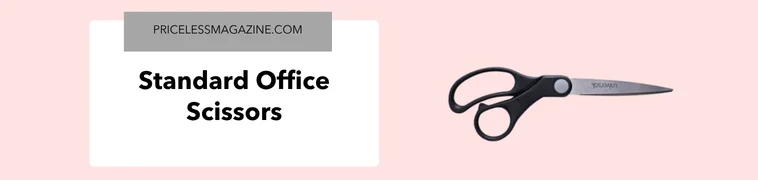
General-purpose office or household scissors sold as “8-inch scissors” measure 8 inches in total length from handle base to blade tip. This labeling convention holds consistently across most brands. The blade itself accounts for roughly half that length and the handle makes up the rest. If the scissors in your desk drawer have a size printed on the packaging, there is a fair chance they are labeled 8 inches.
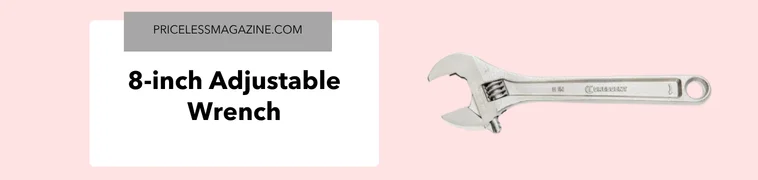
Adjustable wrenches are sold by overall length, and 8 inches is one of the three standard sizes alongside 6 and 10 inches. A Crescent, Irwin, or Stanley 8-inch adjustable wrench measures exactly 8 inches from end to end. This is one of the few everyday objects where the labeled measurement matches the actual measurement precisely, making it one of the most reliable physical references for anyone who keeps a basic toolkit at home.
Body and natural references
These references work best once you have confirmed your own measurements, since body dimensions vary from person to person. Treat them as starting points rather than assumptions.

Measured from the wrist crease to the tip of the middle finger with the hand held flat, the average adult male hand spans 7.6 to 8.5 inches. Average adult female hand spans tend to fall between 6.7 and 7.5 inches. These are averages based on anthropometric data — your own hand may fall outside this range in either direction. The only way to make your hand a reliable measuring tool is to measure it once against a ruler and remember the result. Done once, it works anywhere for life.

A medium banana — not the small variety or the large premium ones sold separately — measures between 7 and 8 inches along its outer curve. The USDA classifies bananas by size, and a medium banana in that classification falls in this range. This reference works well when you need something close to 8 inches and happen to be near a kitchen. It is not precise to the quarter inch, but for visual estimation it holds up well enough for most practical purposes.
Around the house

Trade paperbacks — the larger-format paperbacks sold in most bookstores, as opposed to mass market pocket paperbacks — typically measure 8 to 8.5 inches tall. Mass market paperbacks are shorter, around 6.75 inches, so the distinction matters. If you have a novel on your shelf that came from a general bookstore rather than an airport newsstand, there is a good chance its height is close to your 8-inch reference. Hold it spine up and look at the height of the book from bottom to top.

A standard wooden popsicle stick measures exactly 4 inches long. Place two end to end and you get exactly 8 inches. This is one of the most precise references on this list because popsicle sticks are manufactured to a consistent size across virtually all suppliers. Craft stores and dollar stores sell them in bulk. Unlike organic references such as a banana, combining two popsicle sticks gives you a fixed, repeatable measurement with no estimation required.
How to estimate 8 inches without a ruler
Having a list of reference objects is useful, but being able to estimate on the spot without locating a specific item is more practical in daily life. The method below works consistently once you have done it once.
The hand calibration method
- 1. Hold a ruler or tape measure flat next to your hand with fingers held together and straight.
- 2. Measure from your wrist crease to the tip of your middle finger and note the exact number.
- 3. If that number is close to 8 inches, your flat hand is your reference. If it falls short, note by how much so you can compensate when estimating.
- 4. Practice against a few known objects — a chef’s knife blade, a pair of labeled scissors — until the estimation feels consistent.
Quick tip: a U.S. dollar bill is 6.14 inches long. When you need to estimate 8 inches and have nothing else available, picture a dollar bill plus roughly one-third more length beyond it. That mental addition gets you consistently close without any tools.
How 8 inches compares to nearby measurements
One reason 8 inches is hard to picture is that it sits between several more commonly referenced lengths. This table places it in context so you can triangulate the size from objects you already know.
| Measurement | Common reference object | Difference from 8 inches |
|---|---|---|
| 6 inches | U.S. dollar bill | 2 inches shorter |
| 7 inches | Standard butter knife | 1 inch shorter |
| 8 inches | Chef’s knife blade / office scissors | This measurement |
| 9 inches | Standard dinner plate diameter | 1 inch longer |
| 10 inches | Bread knife blade | 2 inches longer |
| 11 inches | Standard printer paper (height) | 3 inches longer |
Common questions about 8 inches
A quick note on accuracy
The chef’s knife blade, the adjustable wrench, and two popsicle sticks are the three most exact references in this guide — all manufactured to the stated measurement. Every other object above comes with a range rather than a single number, and that range reflects real variation across brands and sizes rather than a vague estimate.
If you are working on something where precision matters, use a labeled tool. If you need a rough visual estimate on the go, the dollar-bill-plus-one-third method or your calibrated hand span will get you consistently close.