
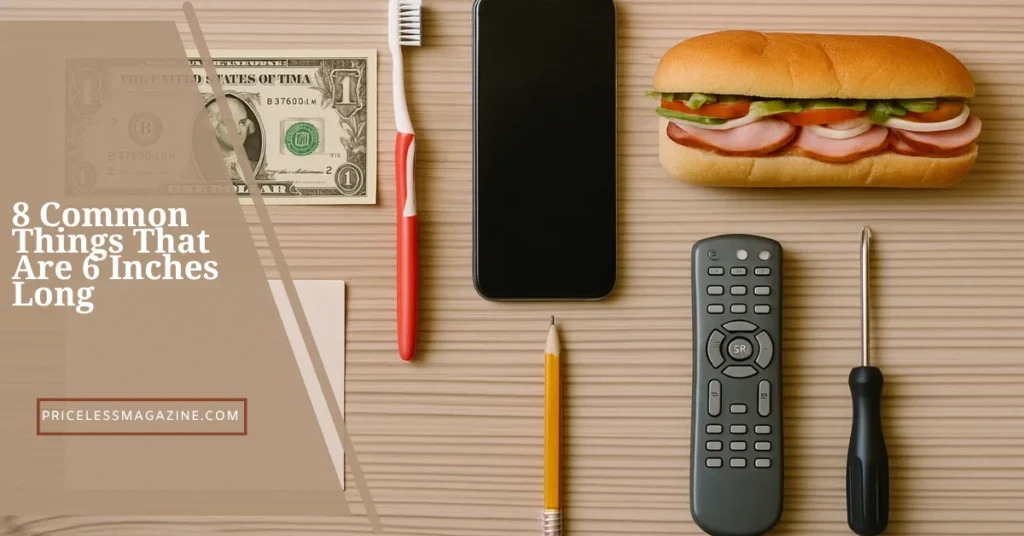

Most people overestimate 6 inches. Ask someone to hold their fingers 6 inches apart without a ruler and they will almost always show you something closer to 8. That gap in perception is exactly why this guide exists — not just to list objects, but to reset your mental picture of what half a foot actually looks like.
Six inches equals 15.24 centimeters. It is exactly half a standard 12-inch ruler. It is shorter than a dollar bill is long — wait, actually it is not. A U.S. dollar bill measures 6.14 inches, which means the bill in your wallet is essentially a pocket ruler for this measurement. That single fact tends to surprise people, and it is a good starting point for recalibrating how you see this length.
The 8 objects below cover your kitchen, your desk, your bathroom, and your pocket. Each comes with a confirmed size range so you know exactly how closely it matches 6 inches rather than a vague approximation.
6 inches at a glance
15.24 cm
In centimeters
152.4 mm
In millimeters
0.5 ft
Exactly half a foot
8 objects that are 6 inches long
These are grouped loosely by where you encounter them — starting with the one you almost certainly have on you right now.

Every U.S. dollar bill regardless of denomination measures exactly 6.14 inches long and 2.61 inches wide. The Bureau of Engraving and Printing has not changed this size since 1928. That 0.14-inch difference from a true 6 inches is smaller than the width of a matchstick, which makes the dollar bill the single most precise portable reference for this measurement that most people already carry. If you fold one lengthwise, the crease runs at exactly 3.07 inches — half of an already near-perfect 6-inch reference.
This is the first object worth memorizing because it is almost always available and consistent to the millimeter across every bill ever printed.

Most adult manual toothbrushes measure between 6 and 7 inches from the end of the handle to the tip of the bristle head. The variation comes from the bristle head size — compact heads bring the total length closer to 6 inches, while full-size heads push it toward 7. Electric toothbrush handles without the head attached typically measure 5.5 to 6 inches. If you want to use your toothbrush as a reference, measure yours once so you know exactly where it falls in that range.
What makes this a useful reference is that you handle it twice a day without thinking. Once you know its length, estimating 6 inches from memory becomes automatic.

A standard butter knife blade — measured from the bolster where it meets the handle to the rounded tip — runs between 5.5 and 6.5 inches depending on the flatware pattern. Most mid-range sets land right at the 6-inch mark. This is the blade alone, not the handle included. The full length including the handle typically reaches 8 to 9 inches, which is a common source of confusion when people try to use a butter knife as a size reference. Focus on the blade from bolster to tip and you have a consistent 6-inch guide sitting in your kitchen drawer.

Remote controls vary more than most people realize. Streaming device remotes — the slim ones that come with Roku, Fire Stick, and Apple TV — typically measure between 5.5 and 6.5 inches long. Standard television remotes from brands like Samsung, LG, and Sony tend to run longer, anywhere from 7 to 9 inches. The smaller streaming remotes are the ones that sit in the 6-inch range. If you have one of these on your coffee table, its length is your reference. A full-size TV remote is not — and that distinction matters if you want to use this category accurately.

The United States Postal Service defines a standard postcard as 6 inches long by 4.25 inches wide — these are the regulated dimensions for postcard postage rates. The long side of a standard postcard is exactly 6 inches, making it one of the few items on this list where the measurement is not a range but a fixed specification. Postcards sold at tourist shops, drugstores, and stationery stores follow this standard because it determines their mailing cost. If you have one lying around or pick one up on your next trip, the long edge is a precise 6-inch reference.

Subway portions its sandwiches by bread length — the 6-inch sub uses a roll that is cut and baked to exactly 6 inches. This is not an approximation based on an average; it is a standardized portion used across all Subway locations. The 6-inch sub has been on the menu since the chain launched its value format, and the bread length has remained the same. If you have eaten one, you have already held 6 inches of bread in your hands. This is one of the most widely recognised real-world examples of this measurement purely because of how familiar the product is.

A standard soup spoon measures exactly 6 inches from the tip of the bowl to the end of the handle. This consistency comes from manufacturing standards that have remained stable across flatware companies for decades — the same standard applies whether you pick up a spoon from a budget set or a restaurant-grade one. This is the large round-bowled spoon used for soup and cereal, not a tablespoon measuring spoon, which is far smaller. The next time you set the table, the soup spoon to the right of the bowl is sitting at almost exactly 6 inches. It is one of the more precise natural references in the kitchen precisely because flatware sizing is standardised rather than organic.

A standard ballpoint pen — a Bic Cristal, Bic Round Stic, or comparable office pen — measures between 5.7 and 6 inches from tip to cap end. The Bic Cristal, one of the most sold pens in the world, measures 5.9 inches. A Pilot G2 retractable measures 5.5 inches capped. These are slightly under 6 inches rather than exactly at it, which is worth knowing if you reach for a pen as a reference. They give you a lower bound — whatever you are measuring that looks about pen-length is around 5.5 to 6 inches, not more.
Why 6 inches looks longer than it is
The reason most people overestimate 6 inches comes down to context. When you picture “half a foot” in the abstract, your brain tends to anchor to a foot-long reference first — a ruler, a subway footlong, a standard sheet of paper — and then halve it mentally. That mental halving is less accurate than it feels because the brain scales lengths logarithmically rather than linearly at small sizes.
The practical result is that people consistently guess 6 inches as somewhere between 7 and 8 inches when asked to mark it without a reference. Holding a dollar bill and comparing it to the object you are trying to measure corrects this immediately. The bill is the fastest recalibration tool available because virtually everyone has handled one thousands of times and has a deep physical memory of its size.
The single most useful takeaway from this page: a U.S. dollar bill is 6.14 inches long. Carry that fact and you carry a ruler. Every other object on this list is worth knowing, but the bill is the one that is always in your pocket.
Where 6 inches sits among nearby measurements
Six inches is easy to confuse with 5 or 7 inches when estimating by eye. This table anchors it to objects you already know so you can triangulate from multiple directions.
| Measurement | Reference object | Difference from 6 inches |
|---|---|---|
| 4.72 inches | CD / DVD diameter | 1.28 inches shorter |
| 5.5 inches | Bic Cristal pen / compact remote | 0.5 inches shorter |
| 6 inches | Dollar bill / standard postcard long side | This measurement |
| 7 inches | Butter knife full length / standard toothbrush upper range | 1 inch longer |
| 8 inches | Chef’s knife blade / office scissors | 2 inches longer |
| 8.5 inches | Width of standard printer paper | 2.5 inches longer |
Questions about 6 inches
The objects worth remembering
Of the eight objects covered above, three are worth prioritising because they are either always available or precisely standardised: the U.S. dollar bill at 6.14 inches, the standard postcard long side at exactly 6 inches, and the Subway 6-inch sub bread at exactly 6 inches. These three come without a range — they are fixed measurements you can rely on without needing to check the brand or model.