
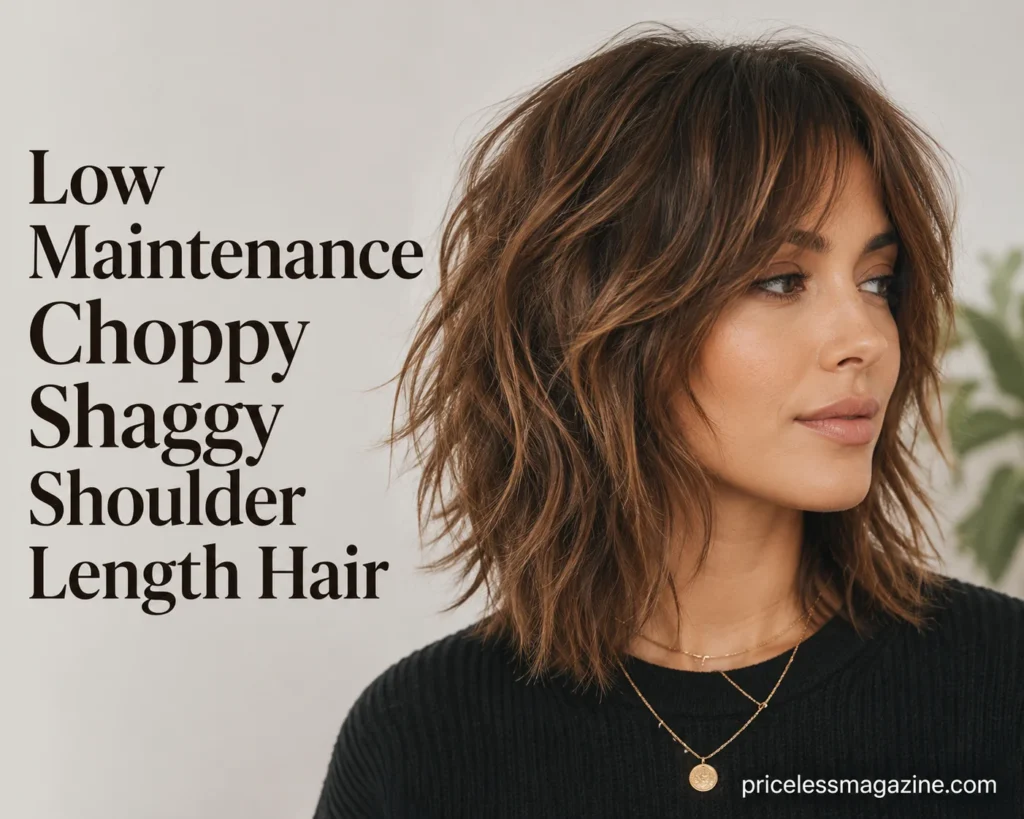

There is a reason this cut keeps showing up everywhere right now. It is not because it is particularly new — the shag has been around since the 1970s and has been revived in every decade since. It is because, at shoulder length with choppy layers, it hits a combination that very few other cuts achieve: it looks intentional and styled even when you have done almost nothing to it.
That is what most people actually want from a haircut. Not a cut that requires thirty minutes of prep. A cut that works with where your hair naturally wants to go.
This article covers everything about the choppy shaggy shoulder length style — what it is, who it suits, how to look after it, and exactly what to say when you sit in the salon chair.
What Makes This Cut Different From a Regular Layered Cut
The words shaggy and choppy are doing specific work here, and they are worth understanding before you book an appointment.
A regular layered cut involves smooth, blended layers that transition gradually from longer underneath to shorter on top. The goal is usually a polished, seamless finish.
A shaggy cut is different in intention. The layers are more pronounced and less blended — you can actually see them, and the movement between each layer is part of the visual effect rather than something the stylist tries to hide. The overall shape has a lived-in, slightly undone quality. At shoulder length, this means the ends of the hair sit with visible texture rather than a flat, even line.
Choppy specifically refers to the cutting technique used on the ends and throughout the layers. Instead of cutting straight across or with a razor, the stylist uses point cutting — snipping into the ends at an angle with the tips of the scissors rather than straight across. This breaks up the line and creates irregular, textured edges. Those irregular edges are what produce the dimensional, moving quality that photographs well and looks effortlessly styled.
Together — shaggy layers plus choppy ends — you get a cut with significantly more visual texture than most shoulder-length haircuts, and one that requires much less styling effort to look like you meant it.
Why Shoulder Length Is the Right Length for This Style
The shag works at multiple lengths — there are short shags, long shags, collarbone shags. But shoulder length specifically hits a practical sweet spot that makes it work particularly well as a low maintenance option.
Long enough to tie back on days when you do not want to think about it. Short enough to air-dry in a reasonable amount of time. Heavy enough to have some natural movement without needing product. Light enough that the choppy layers actually show up rather than being weighted down by length.
At this length, the shaggy layers also land in the right place anatomically. Layers that start around the cheekbone and fall in sections to the shoulder create face-framing movement that longer hair cannot achieve without significant styling, and that shorter hair achieves at the cost of length you might want for versatility.
The grow-out is also more forgiving at shoulder length. When a choppy shaggy cut grows out, it tends to look like a slightly longer version of itself rather than a cut that has lost its shape — which is one of the concrete reasons it lands in the low maintenance category. A blunt bob that grows out looks like a blunt bob with an inch of extra length. A choppy shag that grows out looks like a slightly longer choppy shag.
Who This Cut Suits — Face Shapes and Hair Types
Face Shapes
Oval faces have the most flexibility with this cut. Almost any variation — curtain bangs, no fringe, centre part, side part — works with an oval face shape. If you have an oval face, most of your decision-making is about hair type and personal preference rather than what will flatter you.
Round faces look best when the layers start below the chin line so the cut adds length rather than width. Avoid very full fringe with a round face — curtain bangs parted in the middle are a better choice than a wide, full fringe that sits across the forehead.
Square faces benefit from the soft, uneven edges that choppy cutting produces. The irregular texture softens the angles of a square jaw in a way that a blunt, even cut would not. Face-framing pieces that fall forward around the cheekbones help here.
Heart faces — wide forehead tapering to a narrower jaw — suit this cut well with curtain bangs that balance the width of the forehead against the narrower lower face.
Long faces can wear this cut with shorter, fuller layers and a wider fringe to add the appearance of horizontal width. Avoid very centre-parted, sleek versions which will emphasise length rather than balance it.
Hair Types
Wavy hair is genuinely the ideal match for this cut. The natural movement in wavy hair works with the layering rather than against it — you can air-dry and the waves fall through the choppy layers into a look that looks styled without any effort. The layers also prevent the triangle shape that shoulder-length wavy hair can sometimes create without layering to remove weight at the sides.
Thick hair benefits significantly from the weight removal that choppy layers provide. Without layering, thick hair at shoulder length can feel heavy and can flip or curl outward in ways that need constant correction. The shaggy layers remove bulk throughout the midlengths and ends, leaving the hair lighter, easier to dry, and more manageable overall.
Fine hair gains movement and the appearance of volume from choppy layers, which create the illusion of more density than is actually there. The point-cut ends prevent the flat, stringy appearance that fine hair can develop with blunt cuts. Note that very heavily layered versions of this cut can make fine hair look thin rather than textured — ask for softer layering if your hair is fine, and keep more weight at the bottom.
Straight hair works well but may need a small amount of texture product to show the cut off properly. On very straight, smooth hair, choppy layers can sometimes lie flat rather than moving. A sea salt spray or texturising spray scrunched through towel-dried hair fixes this immediately.
Curly hair suits this cut particularly well at shoulder length because layers at this length define the curl pattern rather than pulling it out with weight. The cut also reduces the puffiness that can develop at the bottom of curly hair when it hits the shoulder without layering to redirect the shape.
The Low Maintenance Reality — What This Cut Actually Needs
Low maintenance in haircuts means different things to different people, so it is worth being specific.
Salon visits: Most people with this cut come in every 10 to 14 weeks. The choppy, uneven ends are designed to look good as they grow out, and the shaggy layers do not require the precision upkeep that a blunt or very structured cut does. You will know when you need a trim because the ends will start to feel heavy and the movement will reduce — not because a sharp line has grown out into a soft one.
Daily styling: The cut is designed to air-dry into something that looks good. For wavy and curly hair, this is genuinely true with minimal intervention — scrunch in some mousse or leave-in conditioner on damp hair and leave it. For straight hair, a quick rough blow-dry with your fingers or a quick pass with a round brush gives the layers lift. Either way, this is a 5-minute hair routine, not a 25-minute one.
Products: A light texturising spray or mousse is usually all this cut needs. Heavy creams and serums flatten the layers and work against the choppy texture the cut is designed to show. Less product is almost always better with a shaggy cut — the texture is built into the shape, not applied from a bottle.
Heat styling: The short answer is that you do not need it for this cut. If you want more defined waves, a quick scrunch through damp hair with a diffuser on low heat takes 10 minutes. If you want sleeker, a brief round brush blow-dry takes the same. But walking out of the shower, applying mousse, and leaving — that is a viable daily routine with this cut.
Variations to Know Before You Go to the Salon
Not all choppy shaggy shoulder-length cuts are identical, and knowing which variation you want before sitting in the chair makes the conversation with your stylist significantly more productive.
With Curtain Bangs
The most popular variation right now. Curtain bangs are a centre-parted fringe that falls on either side of the face rather than straight across the forehead. They blend softly into the face-framing layers of the shag and require very little maintenance — a small amount of mousse and air-drying usually keeps them in place, and as they grow out they look like longer face-framing layers rather than overgrown fringe.
With No Fringe
Clean forehead, all the movement from the layers rather than fringe. This is the most versatile variation — easiest to style, easiest to dress up or down, and flattering on virtually every face shape. Works particularly well for people who have tried fringe before and found the upkeep too frequent.
With a Full Fringe
A soft, blended full fringe rather than a hard-cut line. This variation suits square and round faces particularly well and gives the overall cut a more deliberate, editorial edge. Requires slightly more maintenance — a full fringe needs trimming every 4 to 6 weeks to stay in the right position. Can be styled with a round brush for a smooth finish or scrunched for a more textured look.
Textured Shag With Face-Framing Highlights
Not a different cut exactly, but a colour addition that significantly enhances the effect of the choppy layers. Face-framing highlights — sometimes called money pieces — placed around the front sections of the hair catch light as the layers move and make the texture read more visibly. This is a popular combination request at salons in 2025 because it adds dimension without a full colour change.
What to Say to Your Stylist
Walking in with a photo is always the clearest communication, but knowing the language helps you confirm you are both on the same page.
Ask for: a shoulder-length shag with choppy layers throughout the midlengths and ends. Point-cut ends rather than blunt ends. Face-framing pieces that start around the cheekbone. Layers that remove weight from the midlength rather than only thinning at the ends. If you want fringe, specify whether you want curtain bangs (parted centre) or a soft full fringe.
Ask to avoid: razor cutting if your hair is fine — razor cuts can cause frizz and split ends on fine hair. Very high layers that start at the crown — these create a triangular shape that adds width at the top rather than movement throughout.
Hairstylist Luna Viola, speaking to Glam about the shag’s 2025 resurgence, specifically recommended requesting “a textured shag with some added waves” for a modern result: “The wavy shag is a grown-out pixie with shaggy texture, sexy and chic for all occasions.” The key word in that description is grown-out — the best version of this cut looks like it is in the process of evolving, not like it was cut yesterday.
Products Worth Using With This Cut
You do not need much. These four cover every scenario.
Sea salt spray: The most useful product for this cut on almost all hair types. Spritzed onto damp or dry hair and scrunched through, it adds the kind of texture that makes choppy layers visible and gives the cut its characteristic tousled quality. Moroccanoil Texture Spray and Not Your Mother’s Curl Talk are widely available options.
Lightweight mousse: For wavy and curly hair specifically. Scrunched into towel-dried hair before air-drying, it defines the waves through the layers without stiffening them. The key word is lightweight — heavy mousses can make fine or mid-density hair feel crunchy.
Dry texture spray: Used on fully dry hair when you want more volume without touching the structure of the cut. Spritz at the roots and mid-lengths, scrunch once or twice, and you add significant lift to a cut that has gone flat through the day.
Leave-in conditioner: Particularly important for wavy and curly hair. The layers in this cut mean more exposed ends than in a single-length style, and those ends benefit from light daily moisture to prevent dryness and maintain the clean, defined quality of the choppiness.