
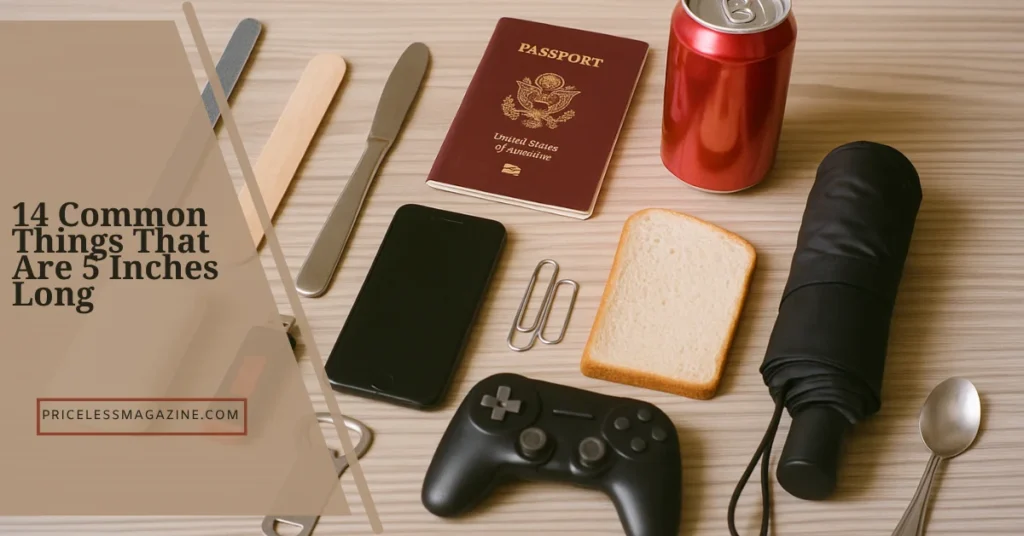

Five inches sits in an awkward spot — too long to be called small, too short to feel substantial. It is the measurement that shows up constantly in product specs without giving you much to anchor it to. This guide changes that by walking through 14 objects you encounter in your daily routine, grouped by where you find them, so the next time you need to picture 5 inches you have at least three familiar options within reach.
Five inches equals 12.7 centimeters. It is slightly less than half a foot — specifically, it falls 1 inch short of the halfway point on a standard ruler. That distinction matters because people instinctively round 5 inches up to “about half a foot” in their heads, which consistently causes them to overestimate the length. A standard 12-ounce soda can stands 4.83 inches tall — barely under 5 inches — and most people, when asked to guess, say it looks closer to 6 inches. That is the gap this guide is designed to close.
Each entry below includes the confirmed measurement or size range. Where a range is given, it reflects real variation across brands rather than imprecision.
5 inches at a glance
12.7 cm
In centimeters
127 mm
In millimeters
0.417 ft
Just under half a foot
In the kitchen
Kitchens are reliable places to find 5-inch references because flatware and cookware sizing follows manufacturing standards that have been consistent for decades.

A standard teaspoon — the eating utensil, not a measuring spoon — runs between 5.5 and 6 inches from end to end across most flatware sets. The handle alone, measured from the base to where the spoon bowl begins, is almost exactly 5 inches in most sets. This makes a teaspoon one of the more consistent kitchen references for this measurement because handle proportions are standardised for ergonomic comfort across manufacturers. Pull one from your cutlery drawer, hold it with the bowl in your palm, and the length of the handle from your palm to the tip is roughly 5 inches.

A standard 12-fluid-ounce aluminum can — the kind used for soft drinks, sparkling water, and beer — measures exactly 4.83 inches tall. That is 0.17 inches under 5 inches, which at normal viewing distance is essentially invisible. The diameter across the top is 2.12 inches and the widest point of the body is 2.6 inches. This is one of the most consistent references on this list because aluminum beverage cans are manufactured to precise specifications by a small number of suppliers. The variation from can to can across brands is negligible — they are all 4.83 inches tall.

A standard slice from a sandwich loaf — the type sold pre-sliced in most supermarkets — measures approximately 4.5 to 5 inches tall and 4 to 4.5 inches wide. The height varies by brand, with thicker artisan loaves producing slightly taller slices. Standard commercial white and wheat sandwich bread tends to fall right at the 5-inch mark vertically. This is an organic reference rather than a manufactured one, so the variation is wider than something like a soda can, but as a rough check it holds up consistently across most mainstream bread brands.
At your desk
Office supplies tend to be among the most precisely manufactured everyday objects, which makes them reliable references when you need something close to an exact measurement.

A 3×5 index card is named for its dimensions — 3 inches wide and 5 inches long. The long side is exactly 5 inches. This is one of the most precise references on this entire list because index cards are cut to specification during manufacturing and the variation is minimal across all major brands. If accuracy matters for what you are measuring, a 3×5 index card is the closest thing to a ruler substitute in a standard office or home. Avery, Oxford, and most store-brand index cards all hold to this dimension consistently.

A capped ballpoint pen measures between 5 and 5.9 inches depending on the model. The Bic Cristal — one of the most widely sold pens in the world — measures 5.9 inches capped. A Pilot G2 measures 5.5 inches. Most standard office pens from Staples, Bic, and Pilot fall in the 5 to 5.9 inch range. Retractable pens without a cap are typically slightly shorter than their capped equivalents. If you have a pen on your desk right now, it is almost certainly within half an inch of 5 inches in either direction, making it a quick and consistent visual reference.

A standard flat emery board nail file measures between 5 and 5.5 inches long. This is one of the most uniform personal care items in terms of sizing — the length is determined by ergonomic function rather than aesthetics, which means variation across brands is small. Metal nail files and glass nail files tend to run slightly shorter at 4.5 to 5 inches, while the classic cardboard emery boards sold in multipacks consistently hit the 5 to 5.5-inch range. The slim, straight shape also makes it easy to use as a flat measurement reference alongside an object you are trying to size up.
In the bathroom

A standard full-size bar of bath soap — a new, unused bar from brands like Dove, Irish Spring, or Ivory — typically measures between 4.5 and 5 inches along its longest side. Dove’s standard bar is 4.75 inches long. Irish Spring measures close to 5 inches. The variation comes from bar thickness and brand formatting rather than length, which tends to stay in this range across most mainstream bars. A new bar of soap sitting in your bathroom is one of the more tactile references for 5 inches because you hold it daily and can feel its length in your hand.

A U.S. passport measures exactly 5 inches tall and 3.5 inches wide when closed — these dimensions are set by the International Civil Aviation Organization (ICAO), which standardises passport dimensions globally. The same 5-inch height applies to passports from most countries including the UK, Canada, and Australia, all of which follow ICAO Document 9303 specifications. If you have a passport at home, its height is one of the most precisely standardised 5-inch references available — it is not a range or an approximation but a fixed international specification.

A standard pocket comb — the flat plastic type sold at pharmacies and in travel toiletry sections — measures between 4.5 and 5.5 inches long. The most common variety, a fine-toothed pocket comb sold individually, tends to land right at 5 inches. These combs are designed to fit lengthwise in a back jeans pocket, which is typically 5 to 6 inches deep, so the sizing is functional rather than arbitrary. A travel-sized or hotel comb is shorter, usually around 4 inches, so the distinction between pocket and travel comb matters if you want to use one as a reference.
In your pocket or bag

A standard bifold wallet measures between 4.5 and 5 inches wide when closed — this sizing is driven directly by the width of a credit card, which is 3.37 inches, plus the folded leather or fabric surround on each side. Most men’s bifold wallets sit right at 4.5 to 5 inches wide. Slim minimalist wallets tend toward the lower end of that range while thicker card-heavy wallets push slightly above it. The wallet in your pocket right now is most likely within a quarter inch of 5 inches in width, making it a portable reference you carry every day.

The iPhone SE 3rd generation measures 5.45 inches tall. The iPhone 13 Mini measures 5.18 inches. The Samsung Galaxy A13 measures 5.93 inches. Among current and recent phones, the compact and mini categories cluster between 5 and 5.5 inches in physical height — not the diagonal screen size, which is always larger. If you own or have handled an iPhone SE or a compact Android phone, that device height is your 5-inch reference. Note that screen size and physical device height are different numbers — a phone described as having a “4.7-inch screen” has a physical body taller than 4.7 inches because the screen measurement is diagonal and does not include the top and bottom bezels.

Standard wooden popsicle sticks sold for craft use measure exactly 4.5 inches long, not 5 inches. This is worth confirming because popsicle sticks are often listed as 5-inch references on measurement sites. A single stick falls half an inch short. However, the distinction is useful — if you want exactly 5 inches using popsicle sticks, use one full stick (4.5 inches) and note that you need to add roughly the width of a fingernail to reach 5 inches. For a closer approximation, a jumbo craft stick, which measures 6 inches, is closer to half the length of two standard sticks end to end.
Worth knowing: a standard popsicle stick is 4.5 inches, not 5 inches. Two placed end to end equal 9 inches — not 10. For an exact 5-inch reference from craft supplies, the long side of a 3×5 index card is the more reliable choice.
Tools and hardware

A utility knife — the mid-size kitchen knife between a paring knife and a chef’s knife — typically has a blade between 4.5 and 5.5 inches long. Wusthof’s utility knife blade is 5 inches. Victorinox’s utility knife is 4.5 inches. Paring knife blades are shorter, usually 3 to 4 inches. The utility knife occupies exactly the right size range for a 5-inch reference. It is smaller and more manageable than a chef’s knife (8 inches), which also makes it easier to hold alongside something you are comparing against. If you have a mid-size kitchen knife that is neither a small parer nor a full chef’s knife, its blade is almost certainly in the 5-inch range.

A standard compact pocket flashlight — the kind sold as an everyday carry item or included in emergency kits — typically measures 5 to 6 inches long. The Streamlight Stylus Pro, one of the most popular compact flashlights, measures 5.3 inches. The Fenix LD12R measures 4.8 inches. Maglite’s compact AA flashlights measure approximately 5 to 5.5 inches. These flashlights are designed to fit in a jacket pocket or glove compartment, which imposes a practical length limit close to 5 inches. A flashlight in this category held alongside whatever you are trying to measure will get you consistently into the 5-inch range.
How to estimate 5 inches reliably
The best approach is to anchor to one object you can confirm exactly, then use it to calibrate everything else. Of the 14 objects above, the 3×5 index card and the U.S. passport are the two most precise — both are manufactured to fixed dimensions that do not vary.
A quick calibration method using your hand
- 1. Lay a 3×5 index card alongside your open hand, palm facing up.
- 2. Note where the 5-inch edge of the card aligns relative to your fingers — does it reach your fingertips, fall short, or go past?
- 3. For most adults the card falls somewhere between the base of the fingers and the first knuckle. Note your personal reference point.
- 4. Once you know that relationship, your hand gives you a 5-inch estimate anywhere — no card required.
The simplest reference to carry: a U.S. passport is exactly 5 inches tall. If you travel with one, you already carry a precise 5-inch reference in your bag. A soda can at 4.83 inches is the next most accessible option — slightly under, but consistent enough for any practical estimate.
How 5 inches compares to nearby lengths
Five inches is easy to confuse with 4 or 6 inches without a reference point. The table below anchors it to confirmed objects on either side so you can triangulate from multiple directions.
| Measurement | Reference object | Difference from 5 inches |
|---|---|---|
| 3.37 inches | Credit card length | 1.63 inches shorter |
| 4.5 inches | Standard popsicle stick | 0.5 inches shorter |
| 4.83 inches | 12 oz soda can height | 0.17 inches shorter |
| 5 inches | 3×5 index card / U.S. passport height | This measurement |
| 5.9 inches | Bic Cristal pen capped | 0.9 inches longer |
| 6 inches | U.S. dollar bill / standard postcard | 1 inch longer |
| 7.5 inches | New unsharpened pencil | 2.5 inches longer |
Common questions about 5 inches
The objects worth remembering first
Of the 14 objects covered above, three are worth prioritising because they are the most precise and most available. The 3×5 index card is exactly 5 inches on its long side and manufactured to specification. The U.S. passport is exactly 5 inches tall by international standard. The 12 oz soda can at 4.83 inches is the most accessible near-reference in most kitchens — close enough for any practical estimate.