
Small measurements are the hardest to visualise accurately. Below 10 inches, the gap between what people think a measurement looks like and what it actually is tends to be widest. This guide covers the full range from 1 to 10 inches across four bands, with confirmed everyday references for each measurement so you can estimate without a ruler in any situation.
Each band in this guide groups measurements that share similar real-world contexts. The 1 to 2 inch range belongs to the world of coins, paper clips, and small hardware. The 3 to 5 inch range covers pocket items, personal care products, and stationery. The 6 to 8 inch range is dominated by kitchen tools, phones, and writing instruments. And the 9 to 10 inch range is where dinner plates, standard rulers, and larger handheld objects take over.
Quick conversions for this range
1 in
2.54 cm
5 in
12.70 cm
10 in
25.40 cm
1 to 2 inches — coins, clips, and small hardware
This is the range most people underestimate. One inch feels smaller than it sounds once you hold a reference object, and two inches is shorter than almost every handheld item most people use daily. Coins and standard paper clips are the most reliable anchors in this range because they are manufactured to precise specifications that do not vary.

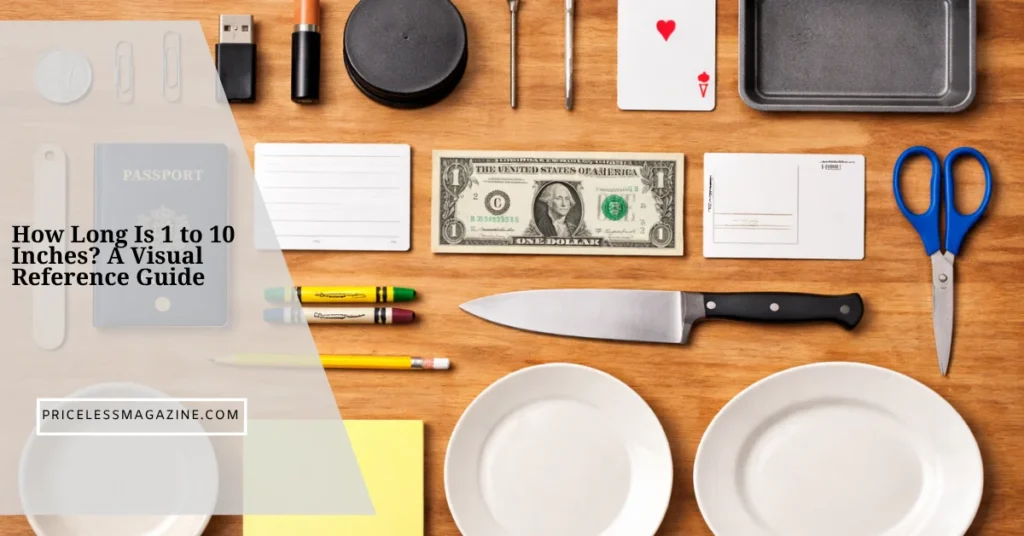
A U.S. quarter has a diameter of exactly 0.955 inches — just under 1 inch by less than the width of a matchstick. The U.S. Mint has maintained this dimension since 1965 with tolerances of 0.003 inches. A standard Gem-style paper clip measures approximately 1 inch at its longest flat side. A USB-A connector — the rectangular plug on chargers and laptops — measures exactly 1 inch from tip to base, standardised globally by the USB Implementers Forum. Your thumb from tip to first knuckle is approximately 1 inch for most adults, though this varies enough between individuals that checking it once against a ruler is worth doing before relying on it.

A standard AA battery measures 1.94 to 1.99 inches tall — just under 2 inches. This dimension is fixed by IEC 60086 international standard and is consistent across every brand from Duracell to Panasonic. A standard six-sided die measures approximately 0.63 inches per side; three dice placed in a row equal approximately 1.9 inches — a close lower-bound reference. Two dice stacked equal approximately 1.26 inches, while two AA batteries standing upright side by side give you 2 inches in height. The credit card’s short side measures 2.13 inches — just over 2 inches — and provides a flat, wallet-accessible reference for this measurement.
3 to 5 inches — pocket items and personal care
This is the range of things that fit in a pocket or a small bag. Most everyday personal care products, stationery items, and small hardware land in this band. The references here are more varied than the coin-and-clip world of 1 to 2 inches because the objects themselves are more diverse.

Three inches has several exact manufactured references. A standard Post-it note is exactly 3 inches on each side — a fixed 3M manufacturing specification unchanged since the product launched in 1980. A regulation hockey puck is exactly 3 inches in diameter as specified by the NHL. A 10d common nail — the standard framing nail for residential construction — is exactly 3 inches long, a fixed industry specification. A standard lip balm tube stands approximately 3 inches tall and a golf tee measures 2.75 to 3.25 inches, with 3 inches being the most common sold size. For a full dedicated guide to this measurement, see our complete article on things that are 3 inches long.

A standard playing card measures 3.5 inches tall and 2.5 inches wide — the height falls just under 4 inches but provides a close and always-available flat reference. A standard wooden popsicle stick measures exactly 4.5 inches long — slightly above 4 inches, making it a close upper-bound reference. A standard bar of bath soap typically measures 3.5 to 4 inches on its longest side. Two AA batteries placed end to end measure approximately 3.88 to 3.98 inches — very close to 4 inches. For a more detailed reference to a nearby measurement, see our full guide on 3 inches and 5 inches for the measurements on either side.

A U.S. passport measures exactly 5 inches tall — this is set by ICAO Document 9303, an international standard that governs passport dimensions globally. A 3×5 index card is exactly 5 inches on its long side. A standard 12 oz soda can stands 4.83 inches tall — just under 5 inches and one of the most accessible kitchen references for this measurement. A compact smartphone such as the iPhone SE 3rd generation measures 5.45 inches in physical height. For a full dedicated guide with 14 confirmed objects, see our complete article on things that are 5 inches long.
6 to 8 inches — kitchen tools, phones, and writing instruments
This is the most densely populated range for everyday objects. Currency, flatware, phones, pencils, and kitchen knives all cluster between 6 and 8 inches. Most adults handle objects in this range multiple times a day, which makes it the easiest range to develop an accurate intuitive sense of once you know the key anchors.

A U.S. dollar bill measures 6.14 inches long — one of the most precise portable references for 6 inches that most people carry. A standard postcard’s long side measures exactly 6 inches, as defined by USPS regulations for postcard postage rates. A standard adult toothbrush measures 6 to 7 inches total length. A Subway 6-inch sub uses a roll baked to exactly 6 inches. Most people consistently overestimate 6 inches — holding a dollar bill and comparing it to what you imagined is one of the quickest ways to recalibrate your mental picture of this length. For a full dedicated guide, see our complete article on things that are 6 inches long.

A new unsharpened standard wooden pencil measures 7 to 7.5 inches long. A standard dinner fork measures 7 to 7.5 inches from handle end to tine tip. Two standard Crayola crayons placed end to end equal exactly 7 inches — each crayon is 3.5 inches, making this one of the most precise 7-inch references available. The iPad 10th generation measures 7.07 inches wide in landscape orientation, sitting right at 7 inches. Most people find 7 inches falls into a gap between familiar references — anchoring it to two Crayola crayons is the most reliable way to lock it in. For a full dedicated guide with 15 confirmed objects, see our complete article on things that are 7 inches long.

The standard chef’s knife blade — from tip to bolster, not including the handle — measures exactly 8 inches. This has been the culinary standard for decades and holds across Wusthof, Global, and Victorinox. Standard office scissors labeled as “8-inch scissors” measure 8 inches from handle base to blade tip — a labeling standard consistent across most brands. Two standard popsicle sticks placed end to end measure exactly 8 inches since each stick is exactly 4 inches. The small side of a standard mouse pad measures approximately 8 to 9 inches. For a full dedicated guide with 14 confirmed objects and a correction table, see our complete article on things that are 8 inches long.
9 to 10 inches — dinner plates and the threshold of a foot
At 9 and 10 inches you are approaching one foot. Both measurements share the same challenge — people consistently underestimate them because they expect something closer to 12 inches when they picture “almost a foot.” The dinner plate is your primary anchor for this entire band.

A standard American dinner plate measures 9 to 10 inches in diameter, with most home tableware sets landing at 9 inches. The short side of a 9×13-inch baking pan is exactly 9 inches — a fixed manufacturing specification used by every major bakeware brand including Pyrex, USA Pan, and Wilton. U.S. letter paper is 8.5 inches wide — half an inch shorter than 9 inches, making it a useful lower-bound reference. A standard hardcover book measures 9 to 9.5 inches tall. For a full dedicated guide with 12 confirmed objects and two common corrections, see our complete article on things that are 9 inches long.

A 10-inch cast iron skillet — one of the most popular sizes from Lodge, Le Creuset, and similar brands — measures 10 inches across the cooking surface from inner edge to inner edge. A large dinner plate at most restaurants measures 10 to 10.5 inches in diameter. A standard iPad Pro 11-inch has a physical height of 9.74 inches, sitting just under 10 inches. Two U.S. dollar bills placed end to end measure 12.28 inches, so 10 inches falls between one and two dollar bill lengths — approximately one dollar bill plus two-thirds of another.
1 to 10 inches at a glance
| Measurement | Best reference object | Metric equivalent |
|---|---|---|
| 1 inch | U.S. quarter diameter / standard paper clip | 2.54 cm |
| 2 inches | AA battery height | 5.08 cm |
| 3 inches | Standard Post-it note / hockey puck diameter | 7.62 cm |
| 4 inches | Standard popsicle stick / playing card height | 10.16 cm |
| 5 inches | U.S. passport height / 3×5 index card | 12.70 cm |
| 6 inches | U.S. dollar bill / standard postcard | 15.24 cm |
| 7 inches | Unsharpened pencil / two Crayola crayons end to end | 17.78 cm |
| 8 inches | Chef’s knife blade / office scissors | 20.32 cm |
| 9 inches | Standard dinner plate / 9×13 pan short side | 22.86 cm |
| 10 inches | 10-inch cast iron skillet / large restaurant plate | 25.40 cm |