
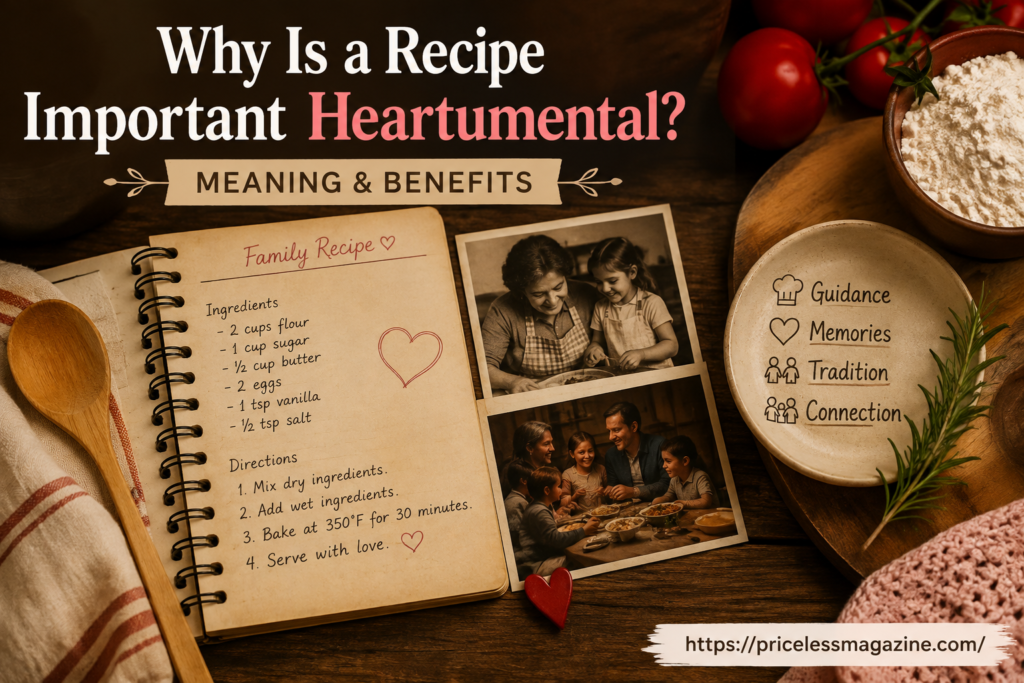

A recipe may look like nothing more than a list of ingredients and cooking instructions, but its importance goes far beyond the kitchen. A good recipe provides structure, prevents mistakes, preserves traditions, teaches valuable cooking skills, and makes it easier to recreate meals consistently.
But what does “heartumental” mean when talking about recipes?
The term heartumental is a modern coined expression that combines the idea of the heart with something fundamental or instrumental. In the context of cooking, it describes the way recipes can serve a practical purpose while also carrying memories, emotions, family traditions, creativity, and cultural identity.
So, why is a recipe important heartumental? Because a recipe is not simply a set of cooking instructions. It can be a practical roadmap for preparing food and, at the same time, a connection to people, places, traditions, and memories.
What Is a Recipe?
A recipe is a structured set of instructions for preparing a particular food or dish. It usually includes the ingredients required, their quantities, preparation methods, cooking temperatures, cooking times, serving sizes, and sometimes additional tips or substitutions.
Think of a recipe as a roadmap.
If you are traveling somewhere unfamiliar, a roadmap helps you understand where you are going and how to get there. In much the same way, a recipe guides you from raw ingredients to a finished meal.
A typical recipe may include:
- A list of ingredients
- Measurements and quantities
- Preparation instructions
- Cooking methods
- Cooking temperature
- Cooking time
- Number of servings
- Storage instructions
- Ingredient substitutions
- Serving suggestions
- Tips for avoiding common mistakes
These details make cooking more predictable and accessible, especially for people who are still developing their kitchen skills.
What Does “Heartumental” Mean?
Heartumental is not a traditional culinary or dictionary term. It is generally used online as a creative combination of concepts associated with the heart and something fundamental or instrumental.
When applied to recipes, the idea is that food can have two important dimensions.
The first is practical.
A recipe tells you what to do, what ingredients to use, how much of each ingredient is needed, and how long to cook the food.
The second is emotional.
A recipe may remind you of a family member, childhood meal, cultural celebration, holiday, friendship, or special occasion.
This combination gives the concept its meaning.
A recipe can therefore be fundamental to successful cooking while also being meaningful to the person preparing or sharing the food.
Why Is a Recipe Important Heartumental?
The importance of a recipe can be understood through several different dimensions. Recipes help people cook accurately, save time, develop skills, preserve food traditions, express creativity, and create meaningful experiences.
Here are the major reasons recipes matter.
1. Recipes Provide Clear Cooking Instructions
One of the most obvious reasons a recipe is important is that it provides a clear sequence of actions.
Without instructions, a person may have to guess:
- Which ingredients to use
- How much of each ingredient is needed
- Which ingredient should be added first
- How high the cooking temperature should be
- How long the food should cook
- When the dish is finished
A recipe removes much of this uncertainty.
For example, someone preparing a cake needs to understand not only which ingredients are required but also how those ingredients should be combined. The order of mixing, oven temperature, baking time, and measurements can all affect the final result.
A well-written recipe makes these details easier to understand.
2. Recipes Help Create Consistent Results
Consistency is another major benefit of using a recipe.
Imagine making your favorite pasta dish today and then trying to make exactly the same dish six months later without remembering the quantities or cooking process.
You might remember the general ingredients, but you may forget:
- How much sauce you used
- How much seasoning you added
- How long you cooked the vegetables
- How much pasta you prepared
- When you added particular ingredients
A written recipe provides a reference point.
This is especially important for baking, where small changes in ingredient quantities can significantly affect texture and structure.
Recipes allow cooks to repeat successful meals instead of relying entirely on memory.
3. Recipes Reduce Guesswork in the Kitchen
Cooking without a recipe can be enjoyable for experienced cooks, but it can be intimidating for beginners.
A recipe provides a framework that reduces guesswork.
For example, instead of wondering whether a dish needs one tablespoon or three tablespoons of an ingredient, the cook has a starting measurement.
This does not mean every recipe must be followed rigidly. Experienced cooks can adjust recipes according to taste, available ingredients, and dietary preferences.
The important point is that the recipe provides a reliable starting foundation.
4. Recipes Help Save Time
A recipe can also make cooking more efficient.
Before starting, you can review the ingredient list and instructions to understand what needs to be prepared.
This allows you to:
- Check which ingredients you already have.
- Purchase anything that is missing.
- Prepare ingredients before cooking.
- Organize cooking steps.
- Estimate how long the meal will take.
This type of preparation can be particularly useful for busy households.
Instead of discovering halfway through cooking that an important ingredient is missing, you can identify the problem before turning on the stove.
5. Recipes Can Reduce Food Waste
Recipes can also help with portion planning and ingredient management.
When quantities are clearly stated, cooks can purchase and prepare more appropriate amounts of food.
For example, if a recipe serves four people and you are cooking for two, you can adjust the quantities accordingly.
This can help prevent unnecessary leftovers and reduce the amount of unused food.
Recipes that include storage and leftover instructions can be particularly useful because they help cooks understand how to handle food after the meal.
6. Recipes Teach Cooking Skills
A recipe is not only an instruction manual. It can also be a learning tool.
A beginner following recipes over time can gradually learn techniques such as:
- Chopping
- Sautéing
- Roasting
- Baking
- Boiling
- Simmering
- Kneading
- Marinating
- Seasoning
- Grilling
- Measuring ingredients
- Controlling cooking temperature
For example, a simple soup recipe can teach someone how to sauté vegetables, balance seasoning, control heat, and determine when ingredients are properly cooked.
As these skills develop, the cook becomes less dependent on recipes and more comfortable experimenting independently.
7. Recipes Build Confidence in the Kitchen
Cooking can feel overwhelming when you do not know where to begin.
A recipe gives you a manageable sequence of steps.
Instead of thinking about the entire meal at once, you can focus on one instruction at a time.
Completing a recipe successfully can also provide a sense of accomplishment.
That experience can encourage someone to try more challenging dishes.
A person who begins with simple recipes may eventually become comfortable creating meals without measuring every ingredient.
8. Recipes Preserve Family Traditions
This is where the heart in “heartumental” becomes particularly meaningful.
Family recipes can preserve traditions that might otherwise disappear.
A handwritten recipe from a parent or grandparent may contain more than measurements and cooking instructions. It may represent a family tradition that has been repeated for decades.
For example, a particular dessert might be prepared every year during a holiday. The recipe helps ensure that younger generations can continue making the same dish.
In this way, recipes can become a bridge between generations.
9. Recipes Preserve Cultural Heritage
Recipes can also preserve cultural identity.
Different cultures have developed unique foods based on local ingredients, geography, history, religion, celebrations, and traditions.
A traditional recipe can document:
- Local ingredients
- Traditional cooking techniques
- Regional flavors
- Cultural celebrations
- Family customs
- Historical food practices
When recipes are passed from one generation to another, they help keep these traditions alive.
Food can therefore become a form of cultural storytelling.
10. Recipes Carry Memories and Emotions
Food is closely associated with memories.
The smell of a particular dish may remind someone of childhood. A familiar dessert may bring back memories of a holiday. A family recipe may remind someone of a loved one.
This emotional connection is one reason the concept of heartumental recipes is meaningful.
The written instructions may be practical, but the story surrounding the recipe can be deeply personal.
Consider a handwritten recipe card covered with notes and stains from years of use.
Technically, it is simply a cooking instruction.
Emotionally, however, it may represent a person, a family, and years of shared meals.
11. Recipes Bring People Together
Cooking is often a social activity.
Families can prepare meals together. Couples can experiment with new dishes. Friends can exchange recipes. Communities can share traditional foods during celebrations.
A recipe provides a common starting point.
Two people can follow the same recipe while adding their own preferences and experiences.
The resulting meal can become part of a shared memory.
In this sense, recipes can contribute to relationships as well as cooking.
12. Recipes Encourage Creativity
Following a recipe does not mean creativity has to disappear.
In fact, recipes can provide the foundation for experimentation.
Once you understand the basic structure of a dish, you can begin modifying it.
For example, you might:
- Replace an ingredient
- Add different herbs
- Adjust the level of spice
- Change the cooking method
- Use seasonal vegetables
- Modify portion sizes
- Experiment with presentation
A recipe therefore acts as a framework rather than an absolute limitation.
The cook can use the framework to create something personal.
13. Recipes Make It Easier to Share Knowledge
Recipes allow cooking knowledge to travel from one person to another.
A skilled cook may know how to prepare a particular dish from memory, but writing down the process makes that knowledge easier to preserve and share.
A recipe can be given to:
- Family members
- Friends
- Students
- New cooks
- Community members
- Online audiences
This makes recipes an important form of practical knowledge.
14. Recipes Are Useful for Meal Planning
Recipes can make weekly meal planning much easier.
Instead of deciding what to cook at the last minute, you can select several recipes in advance and create a shopping list around them.
For example, a weekly meal plan might include:
| Day | Meal | Main Ingredients |
|---|---|---|
| Monday | Vegetable soup | Vegetables, beans, broth |
| Tuesday | Chicken rice | Chicken, rice, vegetables |
| Wednesday | Pasta | Pasta, vegetables, sauce |
| Thursday | Fish and vegetables | Fish, vegetables, herbs |
| Friday | Homemade pizza | Dough, sauce, vegetables, cheese |
This approach can make grocery shopping and food preparation more organized.
15. Recipes Can Support Healthier Cooking Habits
Recipes can also help people become more aware of what goes into their meals.
When cooking at home, people can make deliberate choices about ingredients and portion sizes.
Depending on the recipe, cooks can experiment with:
- More vegetables
- Whole grains
- Beans and legumes
- Fruits
- Lean protein sources
- Herbs and spices
- Different cooking methods
However, a recipe should not automatically be considered healthy simply because it is homemade. Nutritional value depends on the ingredients, quantities, preparation methods, and overall eating pattern.
The advantage of a recipe is that it gives you greater visibility into what you are preparing.
What Makes a Recipe Truly “Heartumental”?
Not every recipe has the same emotional or cultural significance.
A recipe becomes particularly “heartumental” when it combines practical usefulness with personal meaning.
Several characteristics can contribute to this.
Practical Value
The recipe should be clear enough for someone to actually prepare the dish.
Emotional Meaning
The food may be connected to memories, people, celebrations, or personal experiences.
Cultural Importance
The recipe may represent a particular community, region, or family tradition.
Personal Creativity
The cook may have modified the recipe or added a personal touch.
Generational Value
A recipe that can be passed from one generation to another can become a lasting family record.
Recipe vs. Cooking From Memory
Experienced cooks often prepare dishes without written recipes. Does that mean recipes are unnecessary?
Not necessarily.
Cooking from memory is useful when the cook already understands the ingredients, proportions, and techniques.
However, written recipes still provide several advantages.
| Cooking From Memory | Following a Recipe |
|---|---|
| Relies on experience | Provides structured guidance |
| Measurements may vary | Measurements can be recorded |
| Difficult to reproduce exactly | Easier to reproduce |
| Knowledge may stay with one person | Knowledge can be shared |
| Easy to improvise | Easier for beginners |
The two approaches can work together.
A recipe can teach the fundamentals, while experience eventually allows the cook to adapt those fundamentals intuitively.
How to Write a Good Heartumental Recipe
If you want to preserve a recipe for your family or share it with others, consider including more than just ingredients and steps.
1. Give the Recipe a Clear Name
Use a descriptive name that immediately tells readers what the dish is.
2. List Ingredients Clearly
Include exact quantities whenever possible.
3. Explain the Preparation Steps
Write the instructions in the order they should be completed.
4. Include Cooking Time and Temperature
These details are particularly important for baking and oven-based dishes.
5. Mention the Serving Size
Tell readers approximately how many people the recipe serves.
6. Add Helpful Substitutions
If appropriate, explain which ingredients can be replaced.
7. Include Personal Notes
This is where a recipe can become especially heartumental.
You might write:
“This was the dessert our family made every winter.”
A short personal note can transform a basic recipe into a meaningful family record.
8. Record the Recipe’s Story
If you know where the recipe came from, document its history.
You might include:
- Who created it
- Who taught you to make it
- When your family usually prepares it
- Where the recipe originated
- Why the dish is meaningful
These details may become valuable to future generations.
Why Family Recipes Are So Valuable
A family recipe can become an informal historical document.
It can reveal what ingredients a family commonly used, which foods were associated with celebrations, and which traditions were important to them.
A recipe passed down over several generations may even change gradually as different family members adapt it.
One person might add more spices. Another might change the cooking method. Someone else might introduce a new ingredient.
The recipe evolves while retaining its identity.
That combination of continuity and creativity is one of the most interesting aspects of food traditions.
Can a Recipe Be Important Even If It Is Not a Family Recipe?
Absolutely.
A recipe does not have to come from a family member to become meaningful.
It can become important because of:
- A memorable trip
- A special celebration
- A friendship
- A cultural experience
- A personal achievement
- A favorite restaurant
- Learning to cook independently
- Preparing a meal for someone special
The emotional value of a recipe often comes from the experiences associated with it.
The Difference Between a Recipe and a Recipe With Meaning
Consider two recipe cards.
The first says:
Chocolate Cake
- Flour
- Sugar
- Eggs
- Cocoa
- Butter
- Baking instructions
The second contains the same information but also says:
“This is the cake Dad made every birthday. We started making it together when I was eight.”
The cooking instructions may be identical.
The meaning is not.
That difference captures the heartumental idea: the practical instructions help you make the food, while the story gives the food significance.
Frequently Asked Questions About Why a Recipe Is Important Heartumental
Why is a recipe important?
A recipe provides clear instructions, measurements, cooking methods, and timing. It helps cooks reduce guesswork, achieve more consistent results, develop skills, plan meals, and share cooking knowledge.
What does heartumental mean in cooking?
Heartumental is a creative term used to describe the combination of practical and emotional value associated with recipes. It suggests that recipes can be both useful cooking tools and meaningful connections to memories, people, traditions, and culture.
Why are recipes important to families?
Family recipes help preserve traditional foods and cooking methods. They can also carry memories and stories that can be shared with younger generations.
Can recipes preserve culture?
Yes. Traditional recipes can document ingredients, techniques, celebrations, and food customs associated with a particular culture or region.
Why should recipes include measurements?
Measurements provide a reliable starting point and make it easier to reproduce a dish. They are especially important in baking and other forms of cooking where ingredient proportions can significantly affect the final result.
Do experienced cooks still need recipes?
Experienced cooks may not need recipes for familiar dishes, but written recipes remain useful for preserving proportions, documenting variations, teaching others, and recreating dishes consistently.
Can recipes encourage creativity?
Yes. A recipe provides a framework that cooks can adapt. Once someone understands the basic techniques, they can experiment with ingredients, flavors, cooking methods, and presentation.
Why are handwritten recipes special?
Handwritten recipes can contain personal notes, annotations, memories, and evidence of years of use. For families, these details can give a recipe sentimental value beyond the cooking instructions themselves.
Final Thoughts: Why Is a Recipe Important Heartumental?
So, why is a recipe important heartumental?
The answer goes beyond the simple fact that recipes tell us how to cook.
A recipe provides structure, consistency, efficiency, and education. It helps beginners learn, allows experienced cooks to reproduce favorite dishes, and makes culinary knowledge easier to share.
At the same time, recipes can carry memories, traditions, cultural identity, creativity, and emotional connections.
That is what makes the idea of a heartumental recipe interesting. The recipe serves a practical purpose, but its value can extend far beyond the kitchen.
A simple list of ingredients can become a family tradition. A handwritten card can become a treasured keepsake. A meal can become a memory. And a recipe can become the bridge that connects one generation of cooks to the next.
Ultimately, food is rarely just about eating. The recipes behind that food can preserve the knowledge, stories, relationships, and experiences that make meals meaningful.