
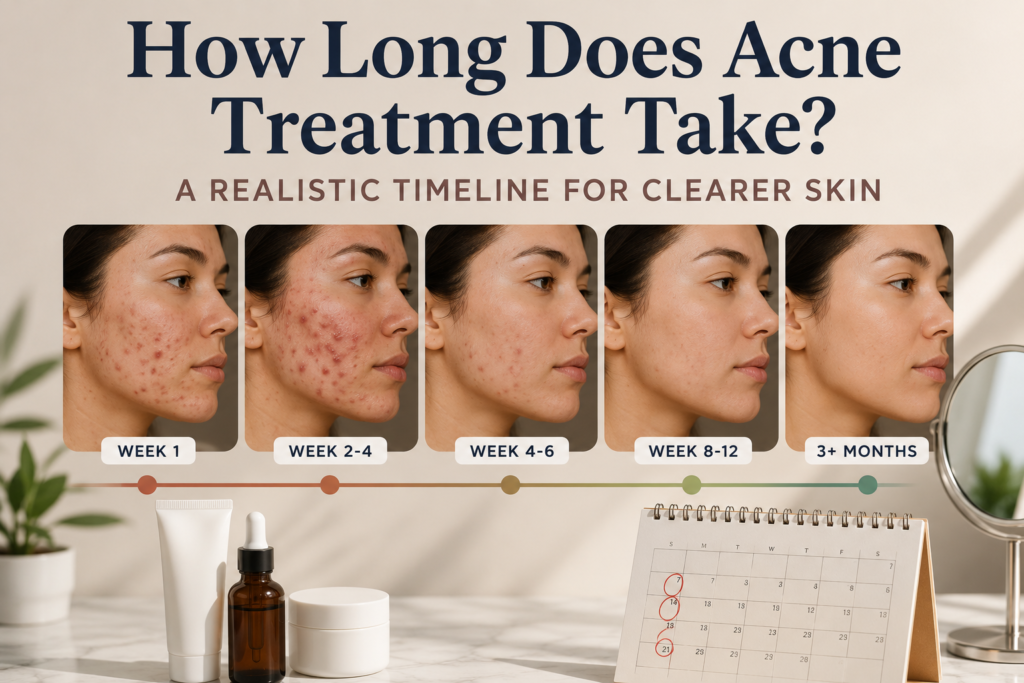

You’ve been on the treatment for three weeks. Your skin looks worse than when you started. And every instinct is telling you to quit.
That’s the moment most acne treatments actually start working, and it’s the moment most people stop. Dermatologists say the single most common reason acne treatment “fails” is that it never gets a fair chance. People expect results in a week, see a purge instead, and walk away.
This is the timeline nobody hands you at the pharmacy counter. What really happens in the first month, when results actually show up, and how to tell the difference between a treatment that isn’t working and one that just hasn’t had enough time.
Quick answer: most acne treatments take 4 to 6 weeks to show the first visible change, and 8 to 12 weeks for significant improvement. The first 2 to 4 weeks often look worse before they look better, because the medication is pushing hidden breakouts to the surface. That phase is called purging, and it’s normal.
What is purging? Purging is the temporary worsening of acne that happens in the first weeks of treatment. Ingredients like adapalene, tretinoin, and benzoyl peroxide speed up skin cell turnover, which forces existing blockages to the surface faster than normal. The result is a wave of breakouts that looks like the treatment failed, but is actually a sign it’s working. Purging usually lasts 2 to 4 weeks and settles on its own.
The first two weeks are the worst part
Expect dryness, redness, and a crop of new breakouts. It’s not a reaction, and it’s not the treatment being wrong for you. Your skin is adjusting to an ingredient that works by speeding up its natural renewal cycle, and that cycle takes about 28 days. You’re seeing week one of a process that needs several full cycles.
The practical stuff matters here. Use a gentle cleanser. Moisturize, even if your skin is oily, because a damaged barrier makes irritation worse. And wear sunscreen every morning, because treatments like retinoids make skin more sensitive to the sun.
When you actually see a difference
At the 4 to 6 week mark, the first visible change usually shows up. Fewer new breakouts. Less redness on the ones that are there. A smoother texture you notice in the mirror rather than in photos.
The 8 to 12 week mark is where the real before and after happens. This is the point most people’s skin looks genuinely, noticeably clearer, and it’s the point dermatologists use as the benchmark for whether a treatment is working.
If you want a realistic preview of what that looks like, real user photos are the most honest source. Epiduo Gel before and after results posted by people who stuck with the treatment for the full 8 to 12 weeks show the same pattern every time: a rough first month, then a steady clearing. The photos that look dramatic are almost always the two-month ones, not the two-week ones.
Why some people take longer
Skin type, acne severity, and consistency all shift the timeline. Cystic acne takes longer than surface breakouts. Darker skin tones often need more time for marks to fade after the acne itself clears. And missing applications stretches everything out, because the treatment needs steady exposure to work.
The 8 to 12 week benchmark assumes you’re using it every day. Spot-treating only the visible pimples is a different, slower game. Applying to the whole affected area prevents new breakouts instead of just chasing the ones you can see.
Purging, or a reaction? Know the difference
Purging shows up where you normally break out, feels like your usual acne, and settles within a few weeks. A true reaction looks different: hives, burning that doesn’t fade, spreading redness, or swelling. That’s not purging, and you should stop and see a doctor.
What actually makes treatment work
Consistency beats intensity. The people who clear up are the ones who keep applying through the ugly first month, moisturize, wear sunscreen, and give it the full 12 weeks before judging. The people who quit at week three are the ones who start over at week ten, usually with the same result and more frustration.
When to see a dermatologist
If you’ve used a treatment consistently for 12 weeks with zero change, if your acne is cystic and scarring, or if you’re not sure what you’re dealing with, that’s the cue to get professional help. Prescription treatments exist for a reason, and the right one for your skin is worth the visit.
Frequently Asked Questions
How long until acne clears?
Most treatments need 8 to 12 weeks for visible clearing, with first changes at 4 to 6 weeks. Purging in the first 2 to 4 weeks is normal. If nothing has changed after a full 12 weeks of daily use, see a dermatologist.
Why is my acne worse after starting treatment?
That’s purging. The treatment speeds up cell turnover and pushes hidden breakouts out faster than normal. It usually lasts 2 to 4 weeks and is a sign the treatment is working, not failing.
Can acne treatment make acne permanently worse?
No. Purging is temporary and clears as your skin adjusts. If breakouts keep worsening beyond a few weeks, or come with burning or swelling, stop and check with a professional rather than pushing through.
Should I use treatment on my whole face or just spots?
Use it on the whole affected area, not just visible pimples. Acne forms below the surface before it’s visible, so treating the full area prevents new breakouts instead of only chasing the ones you can see.