
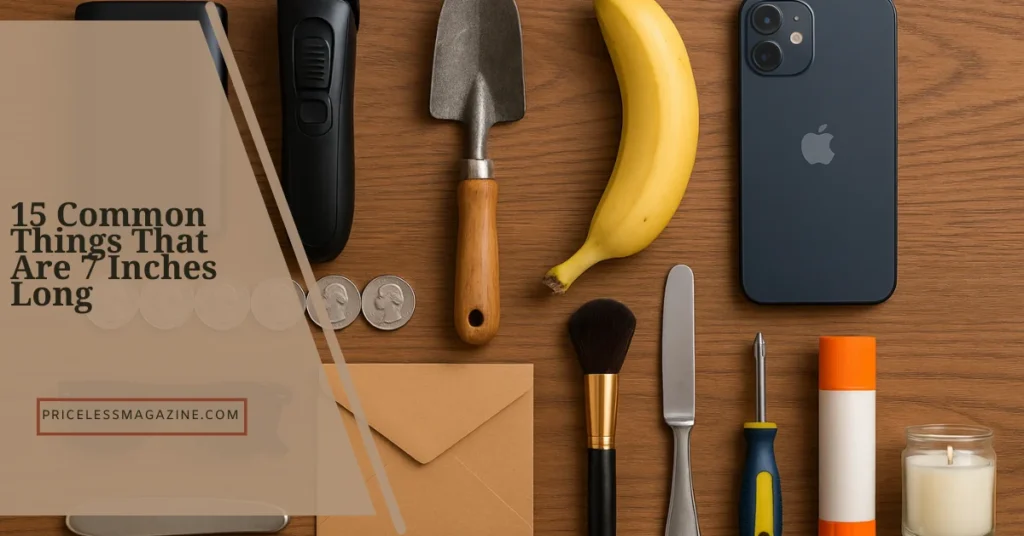

Seven inches falls into a gap that makes it genuinely difficult to picture. It is longer than most people expect when they hear it, and shorter than most people hold their fingers apart when asked to show it. That consistent misjudgment is what makes 7 inches worth understanding properly — not through a number, but through the objects around you that already measure it.
Seven inches equals 17.78 centimeters. It is 1 inch longer than a U.S. dollar bill, 1 inch shorter than a chef’s knife blade, and — for many adults — almost exactly the distance from the base of the palm to the tip of the middle finger. That hand measurement is worth checking once against a ruler because if it holds for you, estimating 7 inches becomes something you can do anywhere, anytime, without reaching for a reference object.
The 15 objects below are drawn from different parts of daily life. Each entry states the confirmed size or range so you know whether you are looking at an exact match or a close reference.
7 inches at a glance
17.78 cm
In centimeters
177.8 mm
In millimeters
0.583 ft
Just over half a foot
Writing tools and office supplies
Writing instruments are among the most standardised everyday objects. Their dimensions are set for ergonomic function and have changed very little over decades, which makes them dependable references.

A brand new, unsharpened standard wooden pencil — the type sold in bulk for classrooms, including Dixon Ticonderoga and Staedtler — measures between 7 and 7.5 inches long including the eraser. This size has remained consistent for over a century because it balances the length needed for comfortable grip against what fits in a standard pencil case. A pencil at the start of the school year is your most immediate desk reference for 7 inches. Once it has been sharpened several times, it drops below this range, so the reference only applies to new pencils taken straight from the box.

Scissors sold as “7-inch scissors” — a common designation for general household and craft scissors — measure 7 inches from handle base to blade tip. This is a labeling standard that holds consistently across most brands. The 7-inch category sits between the smaller 5-inch children’s scissors and the larger 8 to 8.5-inch office scissors. If your scissors are not labeled, check the packaging or the brand’s product page — most household scissors fall into either the 7 or 8-inch category and knowing which one you own gives you a reliable reference for one of these two measurements.

A new, full-length Crayola crayon measures exactly 3.5 inches long. Place two end to end and the total length is exactly 7 inches. This is one of the more precise references on this list because Crayola crayons are manufactured to a consistent size across all standard boxes. Unlike organic references such as bananas or variable ones like toothbrushes, two Crayola crayons give you a fixed, repeatable 7-inch measurement. This is a particularly useful reference for parents and teachers who need to demonstrate the measurement to children using materials already in the room.
Kitchen and dining
Kitchen utensils and flatware are sized for function and follow manufacturing standards that keep them consistent across brands. Several land reliably at or near 7 inches.

A standard dinner knife — the one placed to the right of the plate in a table setting — measures between 7 and 8.5 inches total length including the handle. The blade alone runs 4 to 5 inches. Budget and mid-range flatware sets tend toward the lower end of this range, with many landing right at 7 inches total. Butter knives, which are shorter and more rounded, typically measure 5.5 to 7 inches including the handle. If you want to use a knife from your kitchen as a 7-inch reference, measure it once and note the result — the variation between flatware sets means you cannot assume it without checking.

A full-size dinner fork measures between 7 and 7.5 inches from handle end to tine tip across most flatware patterns. This is the large fork at the left of the plate — not a salad fork, which is shorter at around 6 inches, and not a dessert fork, which falls between the two. Most mid-range American flatware sets produce dinner forks right at the 7-inch mark. If you have a fork in your hand at a meal, there is a reasonable chance it is close to 7 inches long. Check it once against a ruler and it becomes one of the most accessible daily references for this measurement.

The Cavendish banana — the variety that accounts for the majority of bananas sold in U.S. supermarkets — typically measures between 6 and 8 inches along the outer curve. The USDA classifies a medium banana in this range, with many commercially sold bananas landing close to 7 inches. This is an organic reference rather than a manufactured one, so variation is wider than a flatware fork or a pencil. The banana’s curve also means that the measurement along the outside edge differs from the measurement along the straight inner edge. Use it as a general visual ballpark rather than a precise reference.
Technology
Tech device dimensions are published precisely by manufacturers, but the number advertised as the “screen size” is always measured diagonally and does not equal the physical device height. The physical heights below are what matter for size reference purposes.

The iPhone 15 Plus measures 6.33 inches tall physically. The iPhone 15 Pro Max measures 6.29 inches tall. Both are noticeably shorter than 7 inches, which is worth clarifying because larger iPhones are frequently listed as 7-inch references on measurement sites. These phones are closer to 6.3 inches in physical height — approximately two-thirds of an inch below 7 inches. They are useful as a lower-bound reference: whatever you are measuring that looks about as tall as a large iPhone needs roughly another two-thirds of an inch added to reach 7 inches.

The Samsung Galaxy S24 Ultra measures 6.39 inches tall. The S25 Ultra measures 6.41 inches. These are the largest phones in Samsung’s mainstream lineup and they still fall short of 7 inches by more than half an inch. Among current flagship smartphones, no major model reaches 7 inches in physical body height. The largest current phones cluster between 6.3 and 6.5 inches — useful as a lower bound but not a 7-inch reference. A large phone in a protective case adds approximately 0.2 to 0.4 inches depending on the case, bringing some cased phones closer to 7 inches, but the cased measurement varies too much to be reliable.

The iPad 10th generation measures 7.07 inches wide and 9.79 inches tall when held upright. Held horizontally in landscape orientation, the shorter side — 7.07 inches — is one of the closest tech device references to exactly 7 inches currently available. This is the physical chassis width, not the screen measurement. If you own or have used a current iPad, turning it to landscape and looking at the shorter dimension gives you a very accurate 7-inch reference. Earlier iPad generations, including the iPad 7th generation, measured approximately 6.8 inches wide — close but not as precise as the 10th generation.
Personal care

A full-size adult manual toothbrush — not a compact or travel version — measures between 7 and 7.5 inches from the end of the handle to the tip of the bristle head. This size has been settled on across major brands including Oral-B, Colgate, and Sensodyne because it provides enough handle length for adults to grip firmly without pressing the brush head too close to the back of the mouth. Compact toothbrushes run shorter at around 6 inches, and travel brushes are shorter still. If you reach for your toothbrush twice a day, you are holding a consistent 7-inch reference every morning and night without realising it.

A standard oval or rectangular paddle hairbrush typically measures 6.5 to 7.5 inches in total length from the end of the handle to the far edge of the brush head. The handle portion alone is usually around 4 to 5 inches, with the brush head adding the remaining 2 to 3 inches. Brands vary more in brush head size than handle length, which means measuring from handle tip to the base of the brush head gives a more consistent personal reference than measuring the full length. Many mid-size everyday hairbrushes land right at 7 inches overall. Check yours once and it becomes a bathroom reference alongside the toothbrush.
Tools and household items

A small garden trowel — the narrow-bladed type used for transplanting seedlings, digging small holes, and working in containers — typically measures 6.5 to 7.5 inches from the tip of the blade to the end of the handle. Budget trowels and those sold in starter garden sets tend to land right at 7 inches. Larger transplanting trowels and full-size border trowels are longer at 10 to 12 inches, so the size distinction matters. If you have a small trowel in a shed or on a balcony, it is worth measuring once — many people are surprised to find it falls almost exactly at 7 inches.

A full-size television remote control — the type that comes with a Samsung, LG, or Sony television — typically measures between 7 and 9 inches long depending on the model and button count. Simpler remotes with fewer buttons tend toward the lower end of that range at 7 to 7.5 inches. More complex remotes with a full button layout run longer. Streaming device remotes such as the Apple TV remote (5.9 inches) and the standard Roku remote (5.5 inches) are significantly shorter and do not fall in this category. The remote currently on your coffee table may or may not be a 7-inch reference — it depends on the model, so checking is worth the ten seconds it takes.

A standard No. 10 business envelope measures 9.5 inches wide by 4.125 inches tall — neither dimension is 7 inches. This object appears on other measurement sites as a 7-inch reference and that is incorrect. It is included here to correct the record. The envelope that does sit near 7 inches is an A7 envelope, which measures 7.25 inches wide and 5.25 inches tall — designed to hold a folded A7 card. If you are working with invitation or greeting card envelopes rather than letter envelopes, those A7 envelopes are your reference. Standard letter envelopes are not.
Correction note: a standard No. 10 business envelope is 9.5 inches wide, not 7 inches. The A7 greeting card envelope at 7.25 inches wide is the correct envelope reference for this measurement. These two envelope types look similar but differ significantly in size.

A U.S. dime has a diameter of exactly 0.705 inches — this is a fixed specification set by the U.S. Mint that does not vary. Ten dimes placed side by side in a straight line measure exactly 7.05 inches. That is one of the most precise improvised references for 7 inches that you can assemble from objects you carry in your pocket. Unlike coins stacked vertically, which gives height rather than length, ten dimes laid flat in a row is a flat surface measurement you can place directly alongside whatever you are trying to size up. It requires counting carefully, but the precision is hard to match with other everyday objects.
Using your hand as a 7-inch reference
Seven inches corresponds closely to adult hand length for many people, which makes it one of the few measurements where your own body can serve as a reliable reference once you have confirmed it. The key word is confirmed — this only works after you have checked your own hand against a ruler.
How to calibrate your hand for 7 inches
- 1. Hold your hand flat, palm facing up, fingers together and straight.
- 2. Place a ruler alongside your hand and measure from the wrist crease to the tip of your middle finger.
- 3. Note the result. Average adult male hands measure 7.5 to 8.5 inches. Average adult female hands measure 6.7 to 7.5 inches.
- 4. If your measurement falls near 7 inches, your flat hand is your reference. If it falls above, note how much to subtract from your fingertip to reach 7 inches — usually the width of one finger.
- 5. Verify by holding your calibrated hand against a known 7-inch object — a new pencil or a dinner fork — until the estimate feels consistent.
The most reliable quick references: two Crayola crayons end to end (exactly 7 inches), ten dimes in a line (7.05 inches), and a new standard pencil (7 to 7.5 inches). These three give you the tightest measurement without needing to check the brand or model of anything.
Where 7 inches sits among nearby measurements
Seven inches is most commonly confused with 6 and 8 inches. This table places it in context using confirmed objects from both the measurements immediately beside it and the ones further out.
| Measurement | Reference object | Difference from 7 inches |
|---|---|---|
| 5 inches | U.S. passport height / 3×5 index card | 2 inches shorter |
| 6 inches | U.S. dollar bill / standard postcard | 1 inch shorter |
| 6.33 inches | iPhone 15 Plus physical height | 0.67 inches shorter |
| 7 inches | New pencil / dinner fork / two Crayola crayons | This measurement |
| 7.07 inches | iPad 10th generation width (landscape) | 0.07 inches longer |
| 7.5 inches | Standard unsharpened pencil (upper range) | 0.5 inches longer |
| 8 inches | Chef’s knife blade / office scissors | 1 inch longer |
| 8.5 inches | Width of standard printer paper | 1.5 inches longer |
Questions about 7 inches
The references worth locking in first
Of the 15 references above, three stand out for their precision and availability: two Crayola crayons end to end (exactly 7 inches), ten U.S. dimes in a line (7.05 inches), and the iPad 10th generation in landscape orientation (7.07 inches wide). These three are manufactured to fixed specifications and do not vary between individual examples.