
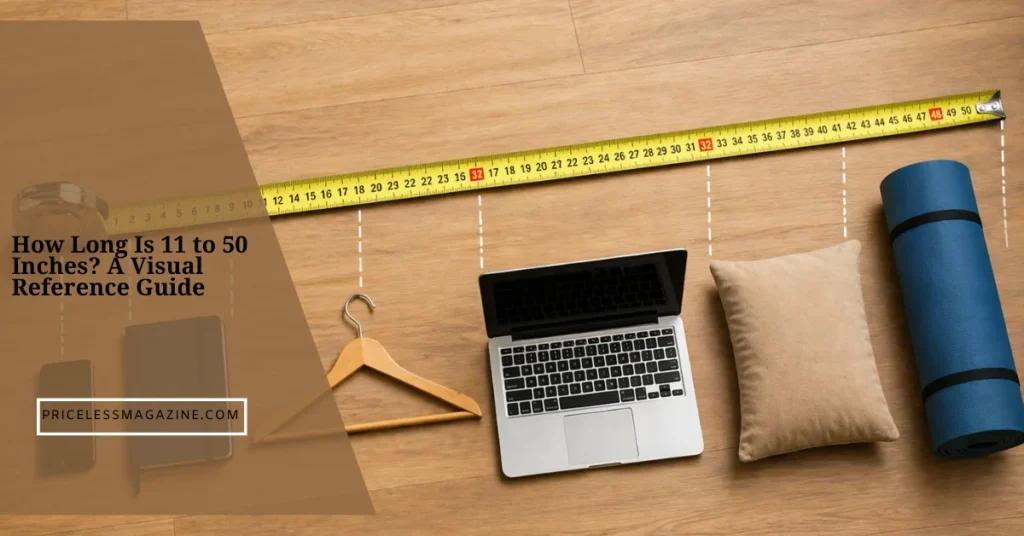

Once measurements move past 10 inches, most people lose their reliable mental anchors. Below a foot you have familiar objects — pencils, rulers, dinner plates. Above a foot, things become harder to picture quickly. This guide covers the full range from 11 to 50 inches across five bands, giving you confirmed everyday references for each measurement so you can estimate without a ruler wherever you are.
Each band covers a logical grouping of measurements that share similar real-world contexts. The 11 to 15 inch range is dominated by tech and paper. The 16 to 20 inch range sits in the space between handheld and furniture-scale objects. The 21 to 30 inch range is where standard furniture dimensions start to appear. The 31 to 40 inch range covers doors, counters, and larger household items. And 41 to 50 inches is where televisions, room dimensions, and sports equipment take over as the primary reference points.
Quick conversions for this range
11 in
27.94 cm
30 in
76.2 cm
50 in
127 cm
11 to 15 inches — the tech and paper zone
This range is anchored by two of the most standardised manufactured objects in daily life — letter paper at 11 inches tall and the 15-inch laptop screen diagonal. Everything in between follows logically once you have those two reference points locked in.

A standard sheet of U.S. letter paper measures exactly 11 inches tall and 8.5 inches wide. The 11-inch height is a fixed specification set by ANSI and has not changed. This is the single most precise and universally available reference for 11 inches — it is in virtually every home printer, notebook, and office. Hold a sheet upright with its long edge vertical and that height is exactly 11 inches. Two other reliable references: a standard composition notebook stands 9.75 inches tall, just under 11 inches, and a vinyl LP record measures 12 inches in diameter, just over 11 inches.

Twelve inches is exactly one foot — the most referenced measurement in the imperial system. A standard 12-inch ruler is an exact reference by design. A vinyl LP record is also exactly 12 inches in diameter, which is where the “12-inch record” name comes from. Other confirmed references: a 2-litre soda bottle stands approximately 12 inches tall, and two U.S. dollar bills placed end to end measure 12.28 inches — barely over 12 inches. The foot is also approximately the distance from a standard adult’s elbow to their wrist, which varies but averages close to 12 inches for most adults.

A 13-inch laptop — MacBook Air 13, Dell XPS 13, Lenovo ThinkPad X13 — has a screen measuring 13 to 13.3 inches diagonally. The physical chassis height of these machines runs 7.5 to 8 inches, so the screen diagonal is the reference, not the device height. A standard full-size clipboard also measures approximately 13 inches long and is a flat, tangible reference most households and offices have within reach. A vinyl LP record in its cardboard sleeve totals approximately 13 inches because the sleeve adds roughly half an inch of protective material on each side beyond the record itself.

U.S. legal paper measures exactly 14 inches tall and 8.5 inches wide — the legal pad on a lawyer’s desk is an exact 14-inch reference on its long side. A 14-inch laptop screen, the most common business laptop size in 2024 and 2025, measures 14 inches diagonally. Models in this category include the Lenovo ThinkPad T14, Dell Latitude 5440, and HP EliteBook 840. A medium pizza at most restaurant chains measures 14 inches in diameter, making it a casual but recognisable reference for this measurement.

The 15-inch laptop is the most common laptop form factor sold globally. Models including the MacBook Pro 15, Dell Inspiron 15, and HP Pavilion 15 all have screens measuring 15 to 15.6 inches diagonally. A medium pizza at most major chains measures 12 to 14 inches, while a large starts at 14 to 16 inches — 15 inches sits right in the transition between the two categories at most restaurants. Two and a half U.S. dollar bills placed end to end measure approximately 15.35 inches, making that combination a useful on-the-go reference for this measurement.
16 to 20 inches — between handheld and furniture scale
This range is where everyday objects start to feel substantial. Most items in your hands are under 15 inches. Most pieces of furniture are over 20 inches in their key dimensions. The 16 to 20 inch range sits between those two worlds — large enough to be clearly visible across a room, small enough to pick up with one hand.

A standard ten-pin bowling pin measures exactly 15 inches tall according to USBC specifications. A guitar neck measured from the nut to the point where it meets the body typically spans 15.5 to 16 inches depending on the scale length. A 16-inch pizza — the large or extra-large size at most pizzerias — is 16 inches in diameter. Two sheets of standard A4 paper placed side by side measure 16.6 inches combined width, which is a flat and accessible reference most people can assemble in seconds. A standard carry-on bag’s width limit of 16 inches is another familiar reference for this measurement for anyone who travels regularly.

A children’s bicycle with 20-inch wheels — the standard size for ages 6 to 9 — has wheels measuring exactly 20 inches in diameter. A small kitchen or office trash can typically stands 20 inches tall. A standard skateboard deck measures approximately 28 to 32 inches long, making half a skateboard close to 15 inches — and the full deck puts you in the 28 to 32 inch range above 20 inches rather than at it. Three U.S. dollar bills placed end to end measure 18.42 inches; adding one credit card length of 3.37 inches brings the total to 21.79 inches, bracketing 20 inches on either side.
21 to 30 inches — standard furniture dimensions begin
The 21 to 30 inch range is where residential construction and furniture manufacturing start using consistent standards. Seat heights, countertop overhangs, cabinet depths, and table widths all cluster in this range. Once you know the key furniture standards, this band becomes one of the easier ranges to anchor mentally.
A standard residential kitchen countertop sits 36 inches above the floor, and the counter depth from wall to front edge is typically 24 to 25 inches. The depth of a standard kitchen base cabinet is 24 inches — which puts it at the lower end of this band. A standard chair seat height is 17 to 19 inches, just below this range. A standard dining table height is 28 to 30 inches, sitting right at the top of this band.
For handheld references in this range: a standard residential oven range is exactly 30 inches wide, and this measurement is worth remembering because kitchen appliances are designed to slot into 30-inch standard cabinet openings. A youth baseball bat for ages 9 to 11 typically measures 28 to 30 inches long. A standard skateboard deck is 28 to 32 inches long. Two standard 12-inch rulers placed end to end are exactly 24 inches.
31 to 40 inches — doors, counters, and room-scale objects
This is the range where objects become clearly room-scale. You are no longer holding these things — you are standing next to them or walking through them. The references here shift from handheld items to architectural and furniture standards.
A standard interior door is 80 inches tall and 32 to 36 inches wide — the width puts it right in this band. A standard kitchen countertop is 36 inches above the floor, which is a measurement most adults have an intuitive sense of from cooking at a kitchen counter. A standard adult bicycle has a wheel diameter of 26 to 29 inches and a total height of approximately 38 to 42 inches from the floor to the top of the handlebars — the lower end of that range sits in this band. A regulation golf club driver measures 44 to 46 inches in total length, just above this band, while a standard 5-iron runs approximately 38 to 39 inches — sitting right within it.
Baseball bats for high school and adult use measure 31 to 34 inches — the entire standard adult bat range falls within this band. A standard yoga mat is 68 inches long but 24 inches wide, putting its width below this range. A standard sofa seat depth is 21 to 24 inches and its seat height is 17 to 19 inches — both below this range — but total sofa height including the back is typically 34 to 38 inches, sitting within it.
41 to 50 inches — televisions, children, and large appliances
At 41 to 50 inches you are dealing with objects that define room layouts. Television screen sizes, the heights of children at various ages, and the widths of major appliances all cluster in this range. These are not hand-held references but spatial ones — you understand them by standing in a room and looking around rather than picking them up.

A standard interior residential door is 80 inches tall and between 32 and 36 inches wide, with 36 inches being the most common for main entry doors and 32 inches for bedroom and bathroom doors. A 42-inch TV screen diagonal is a common entry-level size for living room televisions — the physical width of the TV cabinet for a 42-inch screen is approximately 37 to 38 inches. The average height of a child aged 4 to 5 years falls between 38 and 44 inches, putting 42 inches at the upper end of that age range. These three references — a door width, a small TV, and a child’s height — give you three very different but consistent ways to picture 42 inches in a room.

A 50-inch television screen measures 50 inches diagonally from corner to corner. The physical width of the cabinet for a 50-inch TV is approximately 44 to 46 inches — slightly less than the diagonal measurement because the aspect ratio distributes the diagonal across both width and height. A standard washing machine is 27 inches wide and 36 to 44 inches tall — its height falls within this band at the upper end. The average height of a child aged 6 to 7 years falls between 44 and 50 inches, putting 50 inches at the top of that age range. A standard golf driver is 44 to 46 inches long, sitting just below 50 inches and providing a familiar sporting reference for the lower end of this band.
Full range at a glance
| Measurement | Best reference object | Metric equivalent |
|---|---|---|
| 11 inches | U.S. letter paper height | 27.94 cm |
| 12 inches | Standard ruler / vinyl LP record | 30.48 cm |
| 13 inches | Standard clipboard / 13-inch laptop screen | 33.02 cm |
| 14 inches | Legal paper height / 14-inch laptop screen | 35.56 cm |
| 15 inches | 15-inch laptop screen diagonal | 38.10 cm |
| 16 inches | Bowling pin / large pizza diameter | 40.64 cm |
| 20 inches | Children’s bike wheel / small trash can | 50.80 cm |
| 24 inches | Standard kitchen cabinet depth | 60.96 cm |
| 30 inches | Standard oven range width / dining table height | 76.20 cm |
| 36 inches | Standard kitchen counter height / interior door width | 91.44 cm |
| 40 inches | Adult baseball bat / standard TV entry level | 101.60 cm |
| 42 inches | Wide interior door / entry-level TV screen | 106.68 cm |
| 50 inches | Mid-size TV screen diagonal | 127.00 cm |